Abricots à la Condé
Noblesse Oblige

By dedicating this work to you, Sir, I am repaying my debt of gratitude. - Antonin Carême, Le Pâtissier Royal Parisien, 1815
“Curiosity may well inspire new experiments; the desire for variety may lead to changes which, without altering the fundamental nature of a dish, modify it by means of a simple garnish or decoration. At that point, one may give it whatever name one wishes. An ingenious chef…adds or removes some element from a familiar dish, either in its composition or its presentation, and gives it a fanciful name, often that of the patron to whom he is attached.”
The dawn of the nineteenth century would become a turning point in French cuisine. As the great aristocrats, all those princes and dukes, were swept away to the guillotine or run off to foreign lands, their households were dismantled and the nation’s greatest chefs who served in their kitchens, whose craft was reserved for the pleasure of the nobility and the privileged, had no choice but to adapt to a new world and cook for a new clientele. And so they opened restaurants.
Antoine Beauvillier, esteemed chef who had cooked for the Prince de Condé and M. Comte de Provence, the brother of Louis XVI and future Louis XVIII, opened what is considered the first true restaurant and high-end luxury dining establishment in Paris, Le Beauvilliers, in 1782. He had the extraordinary foresight to take his talents out of aristocratic kitchens and bring the fine dining experience to the public - or to anyone who could afford it - before it became necessary.
Except that up until the Revolution, many of his restaurant clients were aristocrats. So he, too, was run out of business, his restaurant confiscated, and he, the great chef, imprisoned. Liberated 18 months later and disillusioned with politics, he nonetheless decided to open a second restaurant, La Grande Taverne de Londres, bringing, of all things, “the most exquisite and highly praised dishes of English cuisine, which I had the privilege of being the first to introduce to France.”
He quickly understood the need to modify and adapt the recipes prepared in private kitchens for aristocratic tables to an entirely new way of dining, for a paying public, and to the realities of the restaurant.
In 1814, his restaurant booming, Beauvilliers penned and published L’Art du Cuisinier, a cookbook that reflected this significant moment of culinary transition. He simplified and codified the refined cuisine of the great aristocratic households under the Ancien Régime and adapted it to the new restaurant culture of post-Revolutionary France. “Cooking, simple in its origins but refined over the centuries, has become a challenging art and a complex science about which many authors have written, without ever being able to fully grasp it,” he wrote in the introduction.
But he chose to extend his influence beyond the professional kitchen, writing not only for fellow chefs in professional kitchens but home cooks as well: “A mother could find in this book instructions for preparing all well-known dishes, as well as those of my own invention, and oversee their preparation herself.”
And in this changing, post-Revolution culinary landscape, one would imagine the recipes would change, as well. Non?
Well, maybe, maybe not. Sort of.
Beauvilliers and Carême, near contemporaries, both preserved the cuisine of the Ancien Régime in their work and in their cookbooks, its gastronomic opulence, fine ingredients, and elegant presentation, both on the table and on the plate, while trying to bring it to a wider public. But they would also oversee a shift in how dishes were named. For centuries, dishes quite simply bore descriptive names, an indication of its shape (chausson aux pommes), ingredients (navarin d’agneau), physical aspect (neige seiche), or method of preparation (tian or aïgo-boulido). But post-Revolution, chefs suddenly began attaching the names of former patrons or well-known personalities, many of them noble, to familiar recipes. As Beauvilliers wrote (see the opening paragraph), one simply altered a familiar dish or dessert ever so slightly, or added a garnish, or changed its presentation, stuck a fanciful name or the name of one eminent personality or another on the end, and voilà a fabulously elegant dish was born!
It began tentatively, in the early 18th century, when François Massialot introduced dishes à la Reine or à la Dauphine, designations which would last. Joseph Menon followed suit a few decades later, tacking on a variety of nondescript descriptives, a little all over the place, many rather confusing : à la mariée (bride’s style), à l’Abbesse (abbess), à la Gendarme (police), à la Sultane, à la Fermière (farmer’s wife), à la Nourrice (wet nurse), à l’Infante, à la Marquise, and even à la Mousquetaire.
But along comes Beauvilliers and Carême and company and suddenly the aristocracy is making a comeback! Potage à la Condé, côtelettes à la Soubise, boudin de faisan à la Richelieu, potage à la Conti, omelettes or turbot à la Noailles, poulardes à la Pompadour, even filets de soles à la royale … and the list goes on and on.
One of the great ironies of post-Revolutionary France - despite the succession of 2 emperors and 4 kings - was that naming dishes after the aristocracy became quite the fashion. And yet, not everyone approved. In Le Cuisinier Parisien (1828) Carême takes one critic, a Mr. Martin, to task for his grievances :
“In his ‘History of French Cuisine’, Mr. Martin crafts grand sentences that say nothing of substance: it is a jumble of grand, meaningless words and illustrious names cited to draw parallels, in which pedantry and error shine equally bright; and all of this, merely to flaunt his erudition!
And by what right, you writer without a mission, do you insult the culinary arts? What! Will you always pass such senseless and rash judgments? “The names,” you say, “of our dishes have something barbaric and foreign about them, just like the dishes themselves.” What an injustice! What a falsehood! On the contrary, the dishes of French cuisine bear the most illustrious names of the French nobility: à la Reine, à la Dauphine , à la Royale , à la d’Artois , à la Xavier , à la Condé , à la d’ Orléans , à la Chartres , à la Penthièvre , à la Soubise , à la Conti , à la Montmorency , à la Villeroi , à la Pompadour , à la Mirepoix , à la Matignon , à la Montgolfier , à la Mazarine , à la Richelieu , à la Colbert …. Certainly, these names belong to France and are by no means barbaric.”
Carême explains to Mr. Martin, and ultimately to us, that the point is not merely the individuals for whom these dishes, sauces, desserts, or techniques were named. Rather, culinary names preserve history. Over time, the names will become as important as the dishes themselves, as though it were the duty of a great chef not merely to nourish his guests, but to preserve the memory of the great figures of his nation. The irony is that today, few diners or chefs recognize Condé, Soubise, or Colbert as princes, noblemen, or statesman; their names have become inseparable from the recipes or the techniques they once merely adorned.
Barely a century later, Henry Bidou, food columnist, brings it all home with a hefty dose of satire :
“Patriots, moreover, had their revenge. Both the French and the English had a dish bearing the name Montmorency (referring to the noble House of Montmorency, one of France’s oldest aristocratic families) — on the French side, a Savarin; on the English, an ice cream. Thus Old France thus seemed, on both sides of the Channel, to contribute to the destinies of Europe through these cold dishes, one never knows. A journalist even detected in this a stirring sense of (patriotic) glory. Already, in Gabrielle de Vergy, when the heroine recites the dishes her lover’s heart might have devised, she bows, as it were, before riz à la Condé and volaille à la d’Albufera. From the depths of the Middle Ages, she honors those great names of history. Let us likewise honor glace à la Montmorency: it is patriotism of the purest sort—and Caillavet (the author) at his best.”
Food, according to Bidou, had become an expression of patriotism, or, rather, patriotic elegance, with absolutely no meaning, no connection to the dish itself. Any lover will, as Caillavet’s medieval heroine knows, succumb to a dish, no matter how banal, if wrapped in the charm, sophistication, and patriotism of a dish thus named.
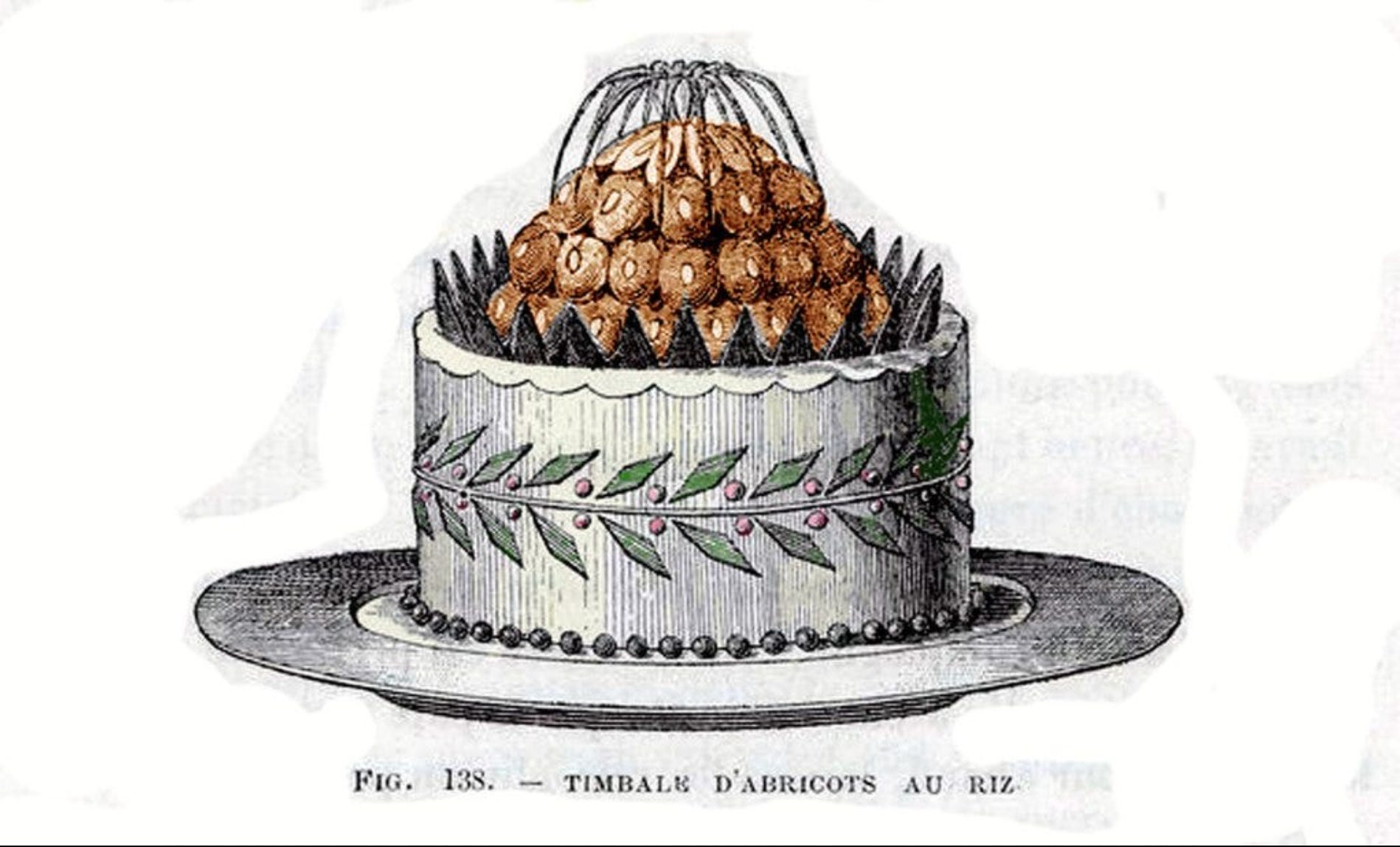
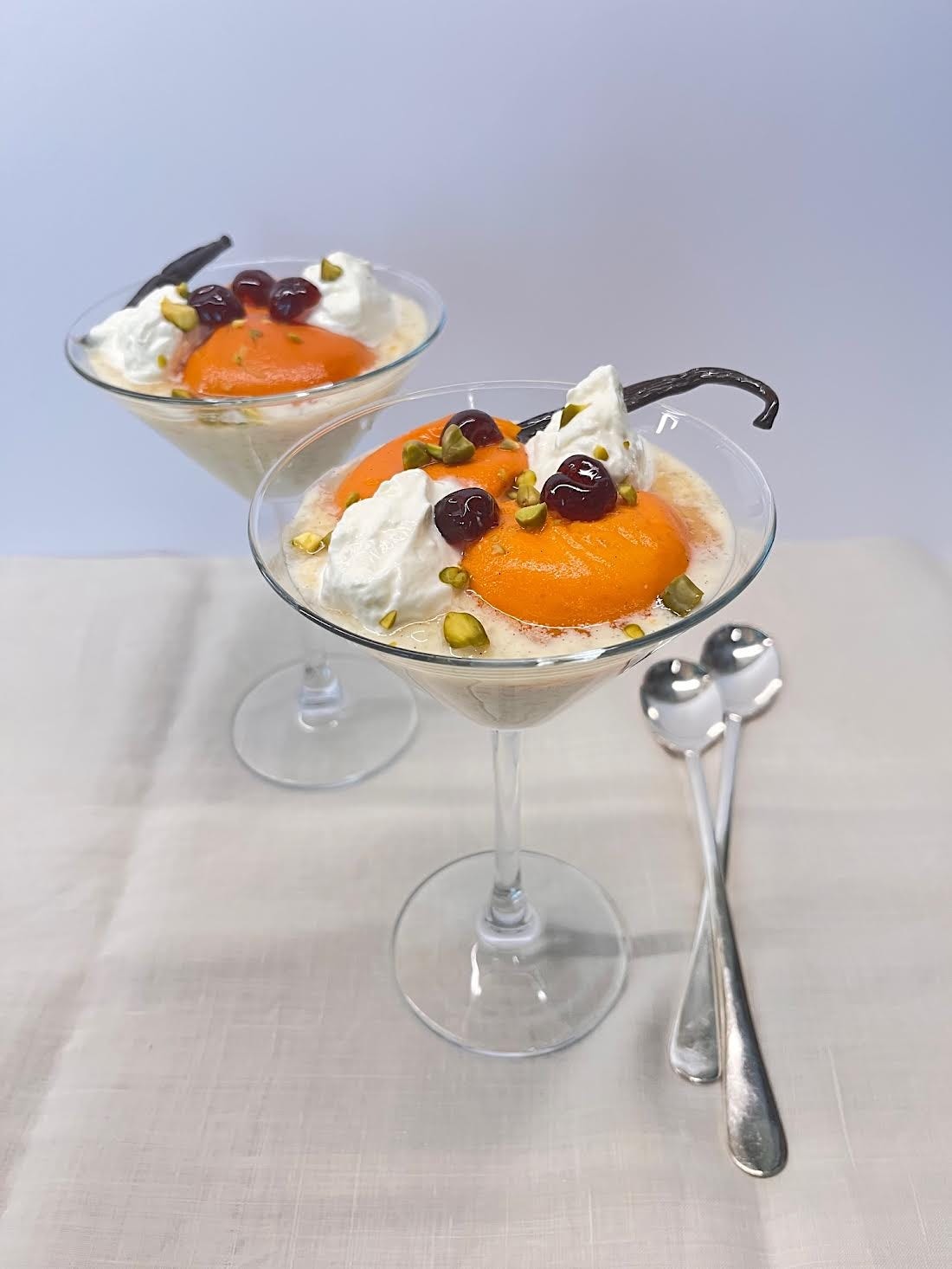
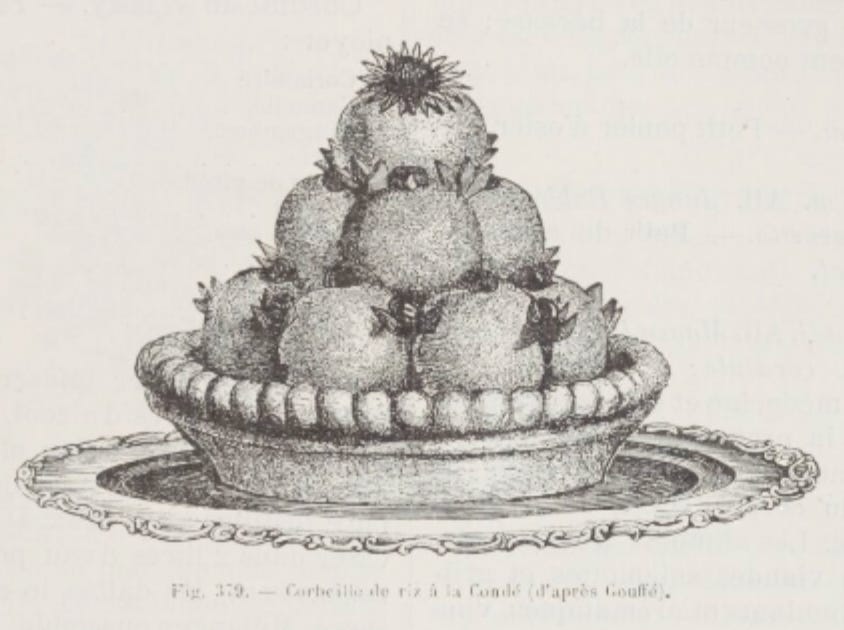
Riz à la Condé and, ultimately, abricots à la Condé, is our hero of this post.
“The cuisine of the age of Louis XIV was refined, sumptuous, and quite beautiful; and it was at the Condé table that people first began to glimpse the heights of refinement it could reach.” - Alexandre Dumas, La Grande Dictionnaire de la Cuisine, 1873
The princes of the House of Condé - among the wealthiest and most powerful princes in France, second only to the royal family - were known for their lavishly sumptuous table, their magnificent and splendid hospitality, and their impressive kitchen staff which included the most illustrious chefs of the day. If any aristocratic name deserves to be on the French menu, it is Condé. So celebrated was their cuisine that Carême himself later recalled that the House of Condé had once been regarded as “the first in the kingdom for the excellence of its table.”
But rice? Who decided to stick their name onto a dish of rice? No one really knows. It is thought by some that this elegant dessert was actually created in the kitchens of the House of Condé. By accident. Possibly by Chef Feuillait (also rumored to have invented or refined puff pastry, pâte feuilletée, although unfounded rumors abound in food history). The story goes that there was confusion, a mix up, at the moment the dishes were brought to the tables (always several tables throughout several rooms for the Condés’ magnificent dinners) and the rice, possibly a sweet rice pudding, or more than likely sweet rice croquettes, ended up being served with the apricots, most likely stewed and sweetened, and everyone loved it!
“Rice prepared in this way serves as the base for many hot and cold desserts, such as apricots, peaches, apples, pears, and bananas — known as “à la Condé” or “à l’Impératrice” — as well as meringues and Creole-style pineapple. It is also used in cakes, puddings, and rice soufflés.” - Auguste Escoffier, Le Riz, 1927
The History of Rice Pudding and the Evolution of Fancier Rice Pudding Desserts


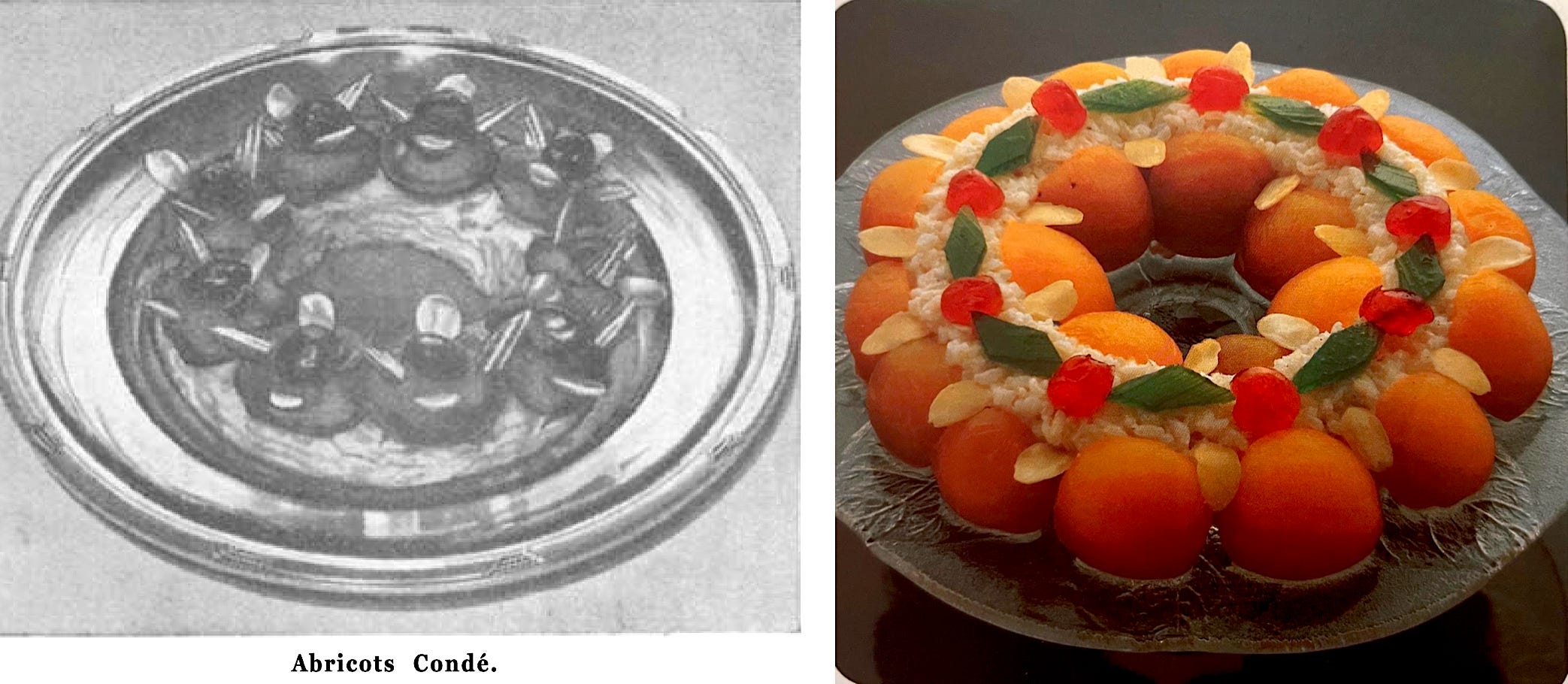
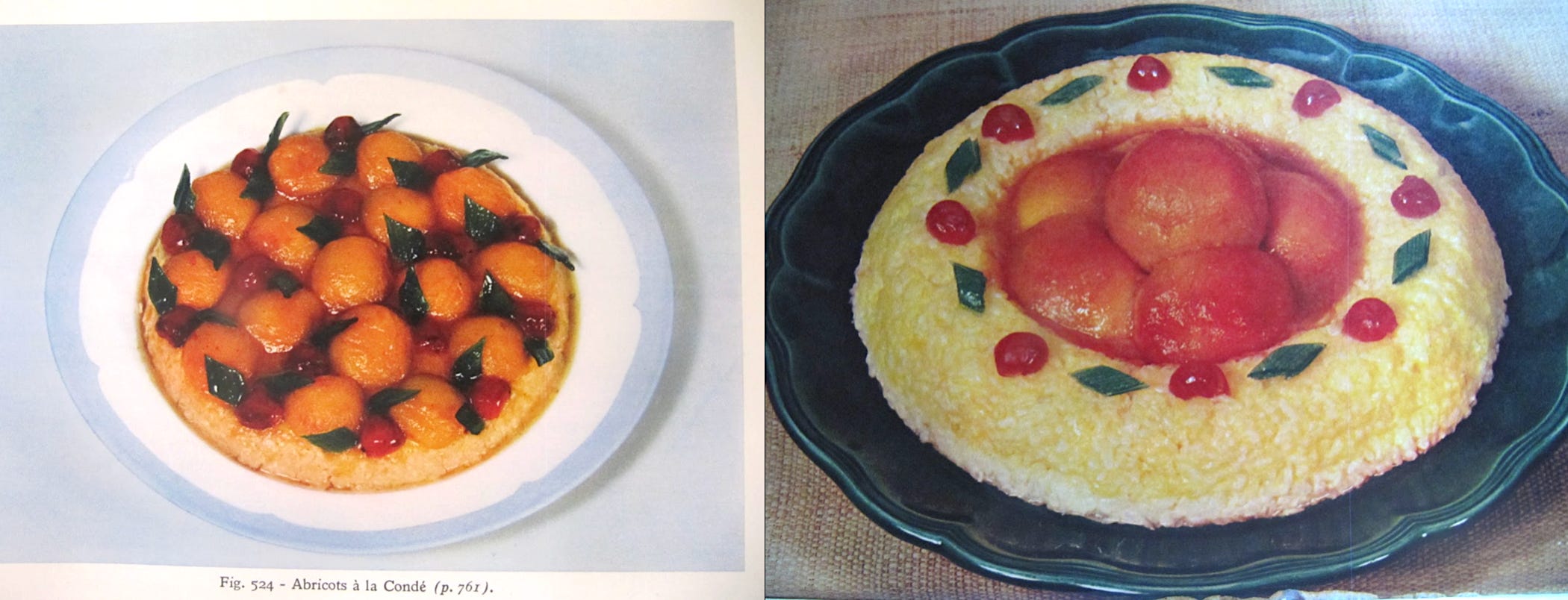
While “riz à la Condé” was seen in cookbooks as early as the 1820s - Carême served a “potage de riz à la Condé”, a savory soup with rice - it is suspected that the first recipe for a sweet version appeared in 1845 in La Grande Cuisine Simplifié by P. C. Robert, chef to the Minister of the Interior, Secretary of the Navy, and the French Ambassador to England, the Count of Saint-Aulaire, not all at the same time. His recipe for Abricots à la Condé did indeed begin with the very same croquettes that were supposedly served with apricots to the guests of the Prince de Condé by error. Robert begins with an enriched sweetened rice pudding flavored with orange flower water, lemon zest or vanilla; half of the prepared rice is used to make a base for the dessert set and shaped on the serving platter, the other half to make about 20 small croquettes in any shape - pear-shaped, prune-shaped, oblong, etc - then fried until a lovely deep golden color. These are arranged around the rice base. A compote made of poached apricots is mounded in the center. The compote is decorated with candied angelica and citron. The poaching syrup is reduced and drizzled over the dessert.
Soon after the recipe appeared in Robert’s cookbook, apricot (and peach) à la Condé began appearing on restaurant menus throughout Paris. Both very quickly found their place and became fixtures - to this day - in the repertoire of French cuisine. Over time, the recipe evolved, or rather, I would argue, was perfected : vanilla found its way into both the rice pudding and the poached fruit, the croquettes disappeared, though the distinctive round or crown-shaped base and decorative arrangement remained. By the 1880s, kirsch had become a standard addition to the sauce.
Some did try to give it a more theatrical flourish, for better or for worse. Mique Grandchamp, in his 1883 Le Cuisinier à la Bonne Franquette, quite literally sets it ablaze: “To make the Condé-style rice more fragrant and visually appealing, pour a little kirsch over it just before serving and set it on fire (flambé it).”
Most of us, though, are quite happy to add the kirsch to the poaching syrup before drizzling this thickened sauce over the finished confection just before serving.
And so, while a generation of chefs helped immortalize the great and illustrious epicures, gourmands, and gastronomic patrons of their day and before, and generations of diners continue to celebrate the Princes de Condé, there were some who lamented the names chosen to be honored. Joseph Favre began his entry on “Condé“ in his Dictionnaire Universel de Cuisine et d’Hygiène Alimentaire (1890) with a thought-provoking reflection :
“The chefs of the Princes of Condé paid their masters every honor they deserved by perpetuating their memory through first-rate dishes. It would have been more fitting for these dishes to bear the name of the great Vatel, chef to the no less great Condé, for whom he died.”
He makes an excellent point.
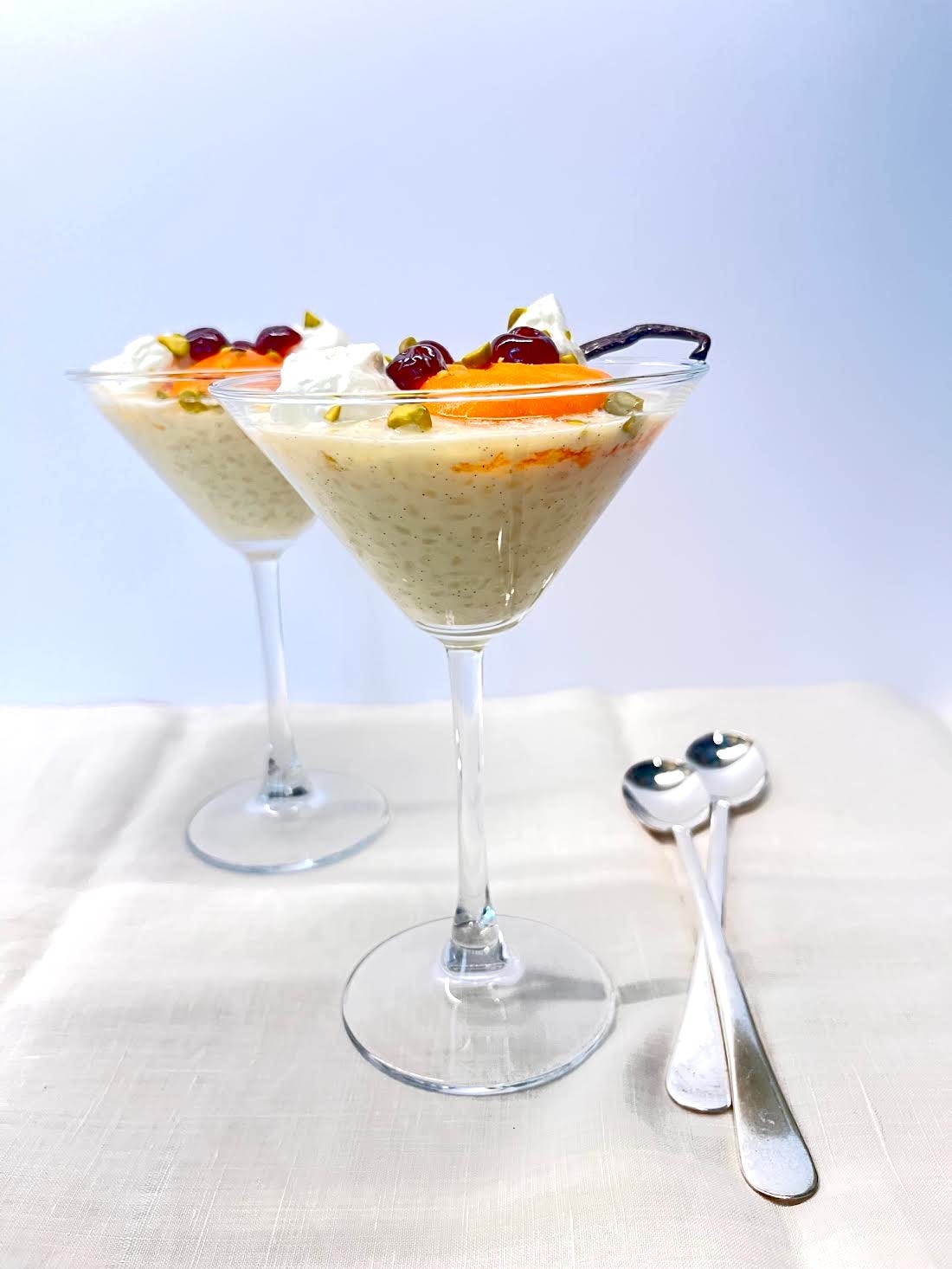
Abricots à la Condé
I prefer a creamier rice pudding so began with a lower quantity rice to milk, basing my recipe on that of Henri-Paul Pellaprat (L’Art Culinaire Français, 1950 and La Cuisine Familiale et Pratique, 1955) ; if you want a firmer rice pudding that you can mold, use 2 cups (200 grams) rice and cook as long as needed until desired consistency. For a richer pudding, replace some of the milk with liquid heavy cream. If you like a pudding that is less sweet, start with a little more that ¼ cup (50 grams) sugar and add more to taste towards the end of cooking, but I find this amount of sugar is perfect with the tart apricots and the warm kick of Kirsch.
Prepare 6 or 8 glass dessert bowls - glass allows guests to see the rice pudding layer - to serve. I find using a soup ladle is the easiest and cleanest way to do this. I made 6 for generous portions. This can also be brought to the table in one large glass serving bowl.
Riz à la Condé
¾ cup (150 grams) uncooked round rice for risotto or pudding
3 ¼ cups (750 ml) whole milk
½ cup (100 grams) sugar
1 vanilla pod, split lengthwise, seeds scraped out, both reserved
1 ½ tablespoons (25 grams) unsalted butter
2 egg yolks
Abricots
12 just-ripe apricots
½ cup (100 grams) sugar
1 vanilla pod, split lengthwise, seeds scraped out, both reserved
2 cups (500 ml) water
Kirsch
Candied cherries or Amarena cherries, for garnish
Candied angelica stems or chopped (coarsely or finely) green pistachios, for garnish
Whipped cream, very lightly sweetened (or not at all), to top
Prepare the riz à la Condé
Place the rice in a fine mesh sieve and run under cold water, rinsing until the water runs clear. Drain.
Place the rinsed rice in a saucepan and cover with water; bring the water to a boil and allow to boil for 5 minutes. Drain the rice in the fine mesh sieve and rinse quickly again under cold water. Drain well.
Return the drained rice to a saucepan with the whole milk, the sugar, and both the vanilla pod and the scraped seeds. Bring just to a boil then reduce to heat to low and cook, stirring constantly, until the rice is cooked and the mixture has thickened, the rice having absorbed almost all of the liquid, about 35 minutes. The rice should be very soft, almost melting in the mouth, yet retaining its shape. It should not be al dente.
Scrape the pudding into a large Pyrex bowl - I do this because I use Le Creuset which retains heat - and immediately whisk in the butter, then vigorously whisk in the 2 egg yolks, one at a time until really well blended - whisking vigorously will keep the yolk from cooking on the hot rice.
Place the bowl in the refrigerator to cool down while you prepare the apricots.
Prepare the apricots
Carefully slice the ripe apricots in 2 lengthwise, discarding the pits.
Blend the sugar, the split vanilla pod and the scraped seeds, and the water in a large saucepan or sauteuse large enough to hold all of the apricot halves in a single layer, even if pushed tightly together. Bring to the boil, stirring, until the sugar is dissolved, lower the heat and place the apricot halves, skin side down, in the liquid. Cook on a very very low simmer just until the apricots are poached and softened; this should only take a couple of minutes as you want the apricots to retain their shape and not dissolve into a compote.
Very carefully scoop out the apricot halves, drain, and place on a plate to cool. Allow the poaching liquid to simmer several minutes until beginning to thicken, add 3 or 4 tablespoons Kirsch (or to taste) before removing it from the heat. Allow to cool; it will continue to thicken slightly as it cools.
To serve
Divide the cooled rice pudding (it can be served warm or tepid) evenly between the dessert bowls.
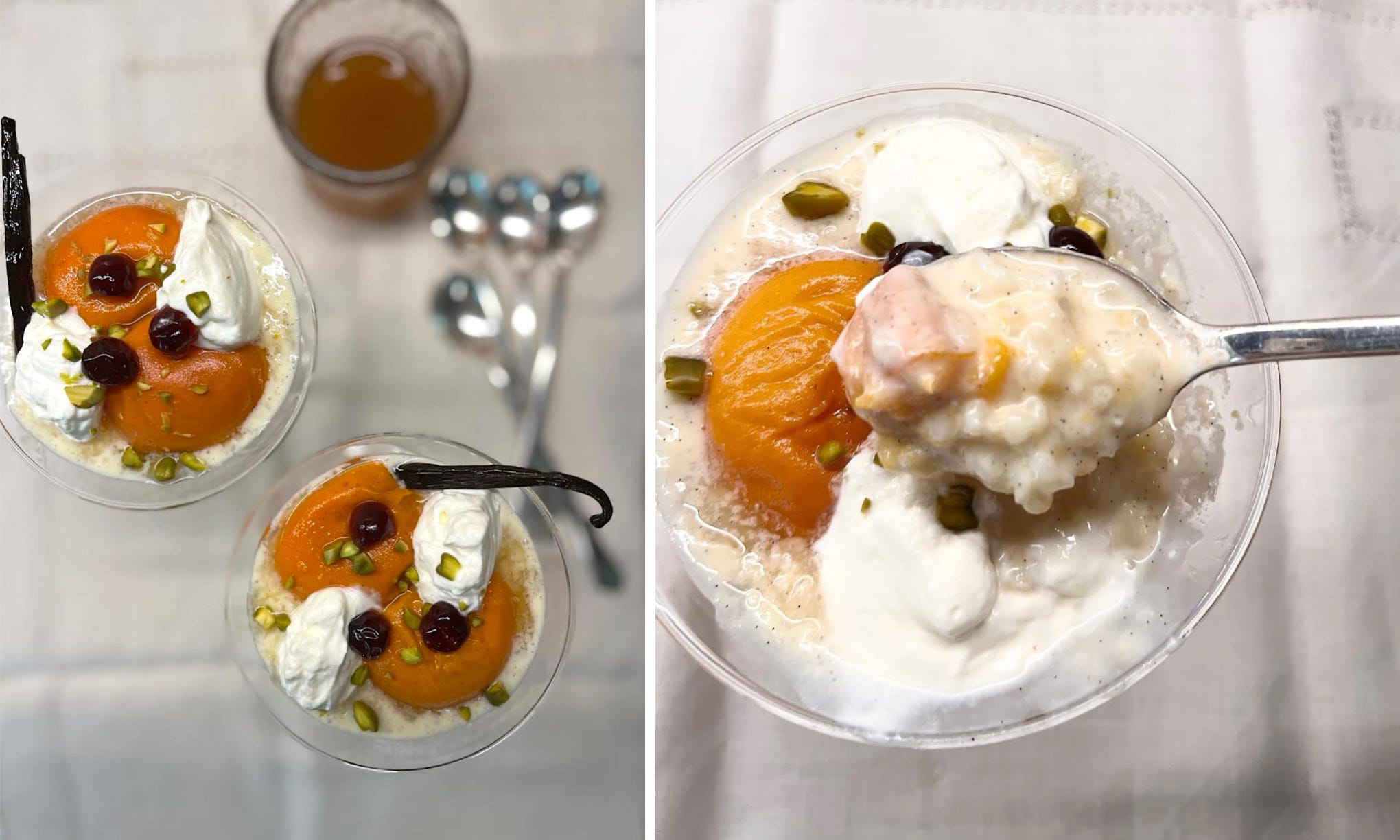
Arrange 3 or 4 apricot halves on top of the rice pudding in each bowl.
Decorate with candied cherries, other candied fruits or Angelica, if you like, or coarsely chopped unsalted green pistachios (for a nice contrast).
Drizzle a spoonful or two of the Kirsch-spiked poaching syrup and spoon or pipe a few dollops of whipped cream on top.
Serve immediately.
Thank you for reading and subscribing to my Substack Life’s a Feast. Please leave a comment, like and share the post…these are all simple ways you can support my writing and help build this very cool community. If you would like to further support my work and the creation and development of the recipes, please consider becoming a paid subscriber.
You've just taken one of my favourite comfort food desserts and bumped it up to a whole new level! Now to just find some Niagara apricots....I know this recipe is going to stay on my mind until I make it!
Magnifique ! Et certainement délicieux !
Incroyable qualité des recherches 🩷