Clafoutis aux cerises
With a cherry on top

I know full well that the love of good food has sometimes gone a bit too far, but what passion doesn’t have its excesses? - Alphonse Karr, introduction to Brillat-Savarin’s Physiologie du Goût, 1826
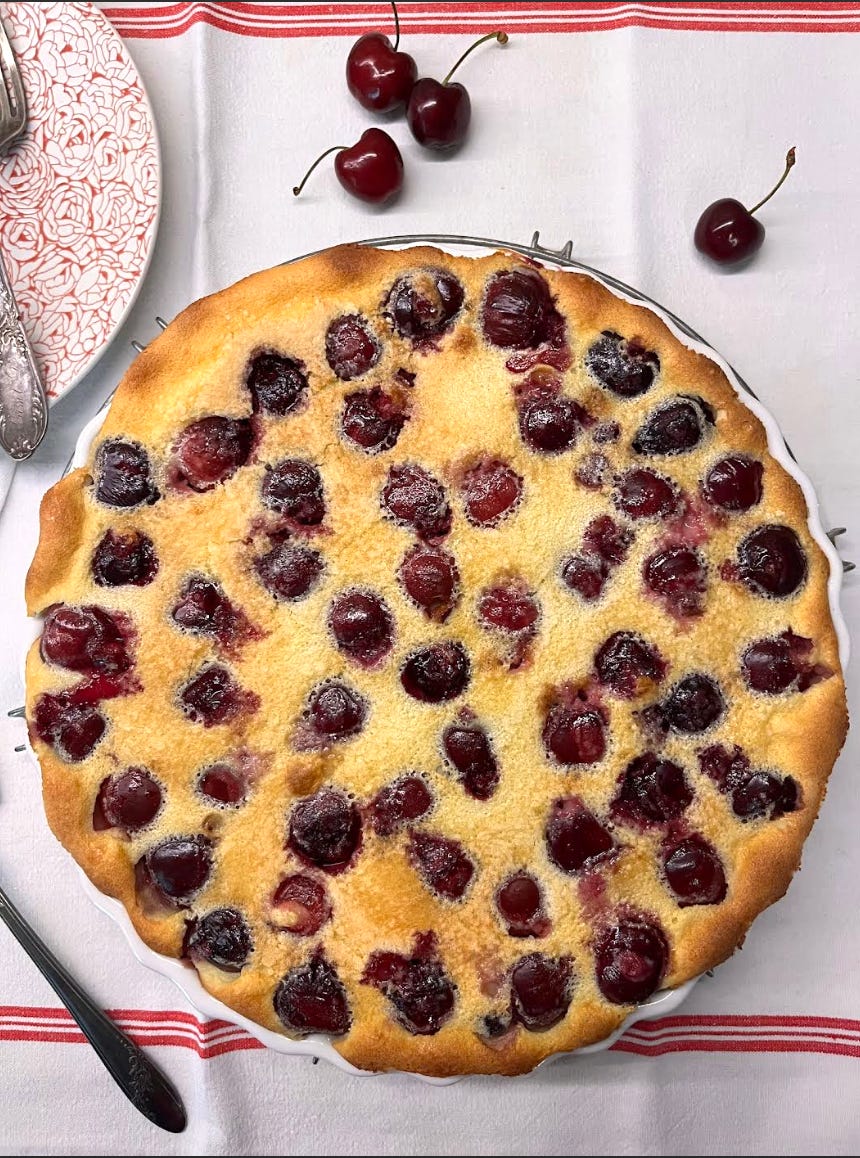
“Since I’ve just told you about a rather special dish from Limousin, and since it’s cherry season, let me also tell you about a seasonal pastry that’s very common in our region. It goes by the decidedly unpoetic name of clafoutis. I can’t guarantee the spelling of the word; Littré and our other dictionary authors are silent on the matter. Perhaps it appears in some Auvergne dictionary that I’m unaware of. In any case, while the name is more than original, I can attest that the thing it refers to is not easy on the stomach, and I am far from having to bestow upon it the praise I have unreservedly and without remorse bestowed upon the gireau, of which the clafoutis is, in a way, the antithesis in terms of digestibility.” - Dr. J. Beaubrun, Causeries Médicales et Scientifiques, 1887
It’s obvious that Dr. Beaubrun didn’t enjoy clafoutis; no praise from him for a regional delicacy that weighed heavily on his poor tummy. He seems to have found it bland, barely worth mentioning, and yet he does. A sign of its importance in the region. A backhanded compliment or two after accolades for the gireau, a traditional lamb’s blood sausage from the Limousin region of France. Much more to his taste.
The good doctor might very well be surprised, then, at the popularity of a pastry that has become an internationally beloved icon of French home baking.
I’ve written about “the amiable flognarde, the humble sister of the clafoutis” in a past Substack post, but never about the more famous of the two. Funny, I can’t even remember the last time I made a clafoutis; rather, I make flognarde and far Breton. Maybe it’s because apples and prunes are more accessible year round. And more affordable. Or maybe it’s because I never found a really excellent clafoutis recipe, a recipe that creates a creamy flan-like base rather than a tough, chewy one. Well, we’ll see.
Like the flognarde, the tôt-fait, and the flamousse, the clafoutis is difficult to trace much before the 19th century when it suddenly appeared on the written page. A staunchly local speciality, clafoutis (or clafouti) was barely mentioned outside of the Limousin province or dialectic glossaries and dictionaries; like the others, it was a humble family treat found on country tables and in the nursery. Sometimes called a flan, sometimes a tart, a tourte, or even a cake with cherries, the clafoutis was finally presented to the French public, brought right into the mainstream and into bourgeois homes, when Urbain Dubois published a recipe for the clafoutis aux cerises in his 1888 Nouvelle Cuisine Bourgeoise Pour la Ville et pour la Campagne. Why it became so well known and - eventually - internationally popular, leaving the others to their rustic and regional obscurity, we’ll never know.

Like the other simple, modest, homey desserts, the clafoutis is a variation on the crêpe, although now the batter poured over dark cherries then baked in a shallow dish. But not just any cherries will do! Fruit specialist André Leroy insisted upon the Guigne Noire des Bois - the Black Wildwood Guigne Cherry - a small, deeply colored, highly flavorful wild cherry that 19th-century authors — and Leroy, a cultivator and gardener, himself — maintained were necessary for an authentic clafoutis. In his 1877 dictionary of ancient and modern fruits, Leroy refers to the Guigne Noire des Bois as the Guigne à Clafoutis, writing : “Highly sought after in the Creuse department for making Clafoutis - an excellent style of tart, though hardly suited for weak stomachs - this wild cherry was completely unknown to the horticulturists of Western France when I introduced it to my estate in 1869.”
In his 1856 Glossaire du Centre de la France, Hippolyte-François Jaubert defined the true country clafouti as a “cake of small black guignes, which contains as much of these fruits as it does batter.” The preparation - and the depiction - of the clafouti(s) was deliciously simple : “One places the liquid batter, in which the guignes are suspended, into a dish with slightly raised edges, and bakes it in the oven.”
Edmond Richardin agrees that “the blacker they (the cherries) are, the better they will be,” making the specificities of the fruit the essential starting point for the creation of the dish itself. “The bigarreau cherries celebrated in song by Victor Hugo,” Richardin continues, “are not good cherries for a clafoutis. Once black cherries are placed at the bottom of the dish, pour over them the sort of batter formed by the flour thinned out with the eggs and milk… It is not an aristocratic dish, but when it is successful (I have made it myself at times) it is delicious. And besides, it is the food of childhood, the food of one’s home country! It looks good, and it always tastes good.”
The food of childhood, the food of home, nostalgic and comforting.
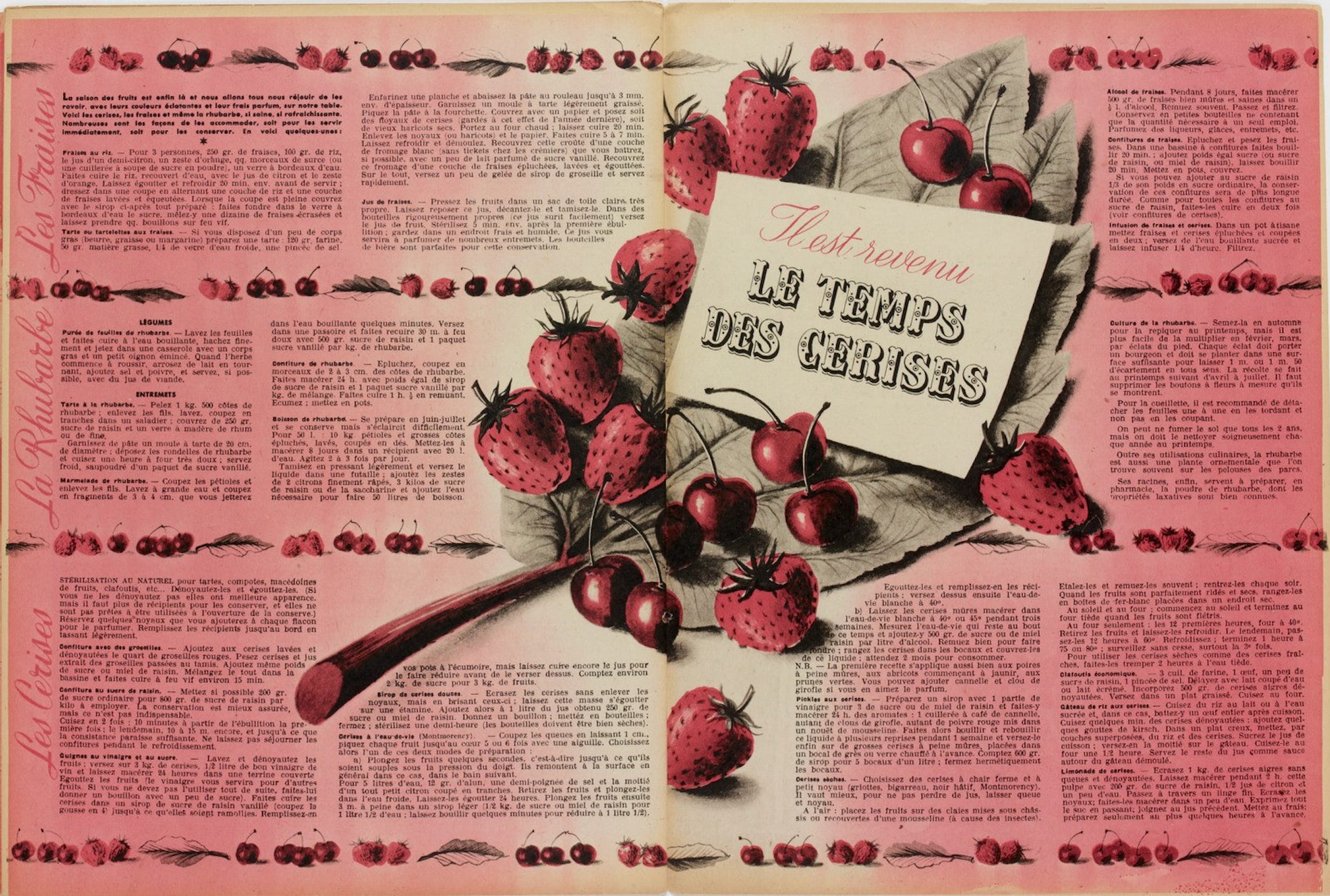
The dark, round aspect of the cherries dotting the pale custard was more than just a dramatic contrast of colors — it was the source of the dessert’s name. Clafoutis (historically spelled clafouti or glafouti) stems from the Limousin dialect of Occitan (clafotis), derived from the old French verb claufir, meaning “to fix or fasten with nails.” Looking down at the finished dish, the visual metaphor is unmistakable: the heavy, dark guigne cherries appear to literally “nail” the rising, dense batter to the baking pan.
Another hypothesis for the origin of the name was put forward by Lemouzi, a regional journal dedicated to preserving the local Occitan language, which suggested that the name “clafoutis” was, in fact, a corruption of the word clafit or claufit, full or filled, the clafoutis being a dish filled to bursting with cherries.
“The clafoutis, a Limousin dish as hearty as the region’s thick cabbage soup, was already baking in the oven, with its black cherries embedded in the flour mixed with water, like bricks set into the clay dish.” - Catissou by Jules Claretie in L’Univers Illustré, 1889
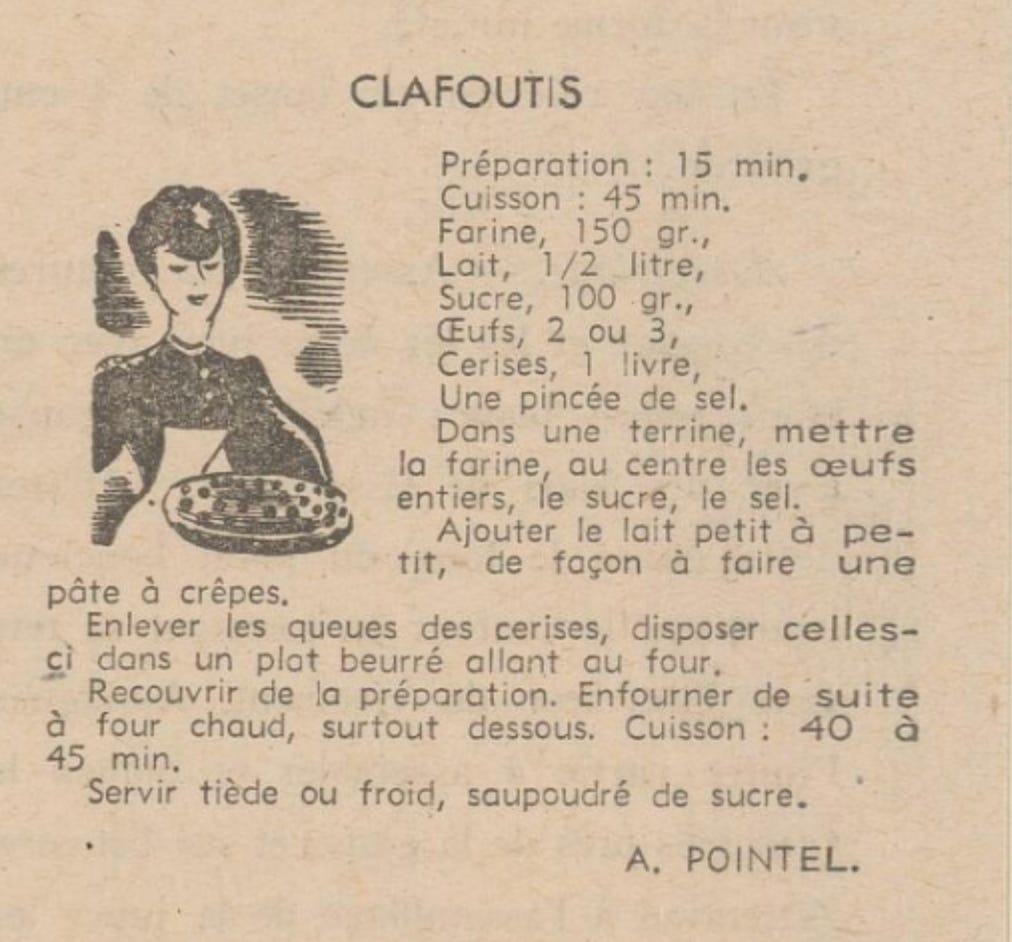
And so now the question is : does one pit the cherries before smothering them in the batter, or does one leave them whole ? While I have heard over and over again that the French leave the pits in, that it is utterly sacrilegious to remove the pits, the French seem rather split on the question and always have been. Some say yes, some say no. Urbain Dubois pitted his. Curnonsky does not. Dr. Beaubrun, he who, above, warns us about the digestibility of the clafoutis, adds his own two cents on the subject :
“Therefore, eat clafouti only with moderation and circumspection. It is a heavy dessert that suits only those enthusiasts blessed with a time-tested, proven digestive power. Furthermore, you know the old prudish refrain:
If you are eating prunes,
Do not swallow the stones...
This advice is, I trust, superfluous for you, my dear reader, but watch over the children with the greatest care, for almost all of them are utterly frantic gluttons when it comes to clafouti (and stone fruits).”
Leave it to a fussy nineteenth-century physician to take the joy out of dessert.
For my part, I want the experience of eating clafoutis to be one of pure, uninterrupted joy. Therefore, I remove the pits for easier eating. Not only does one avoid choking (and breaking a tooth), but one can certainly enjoy each mouthful of this sweet dessert with its boisterous bursts of tartness infinitely more when not having to constantly search around in the mouth for a pit.
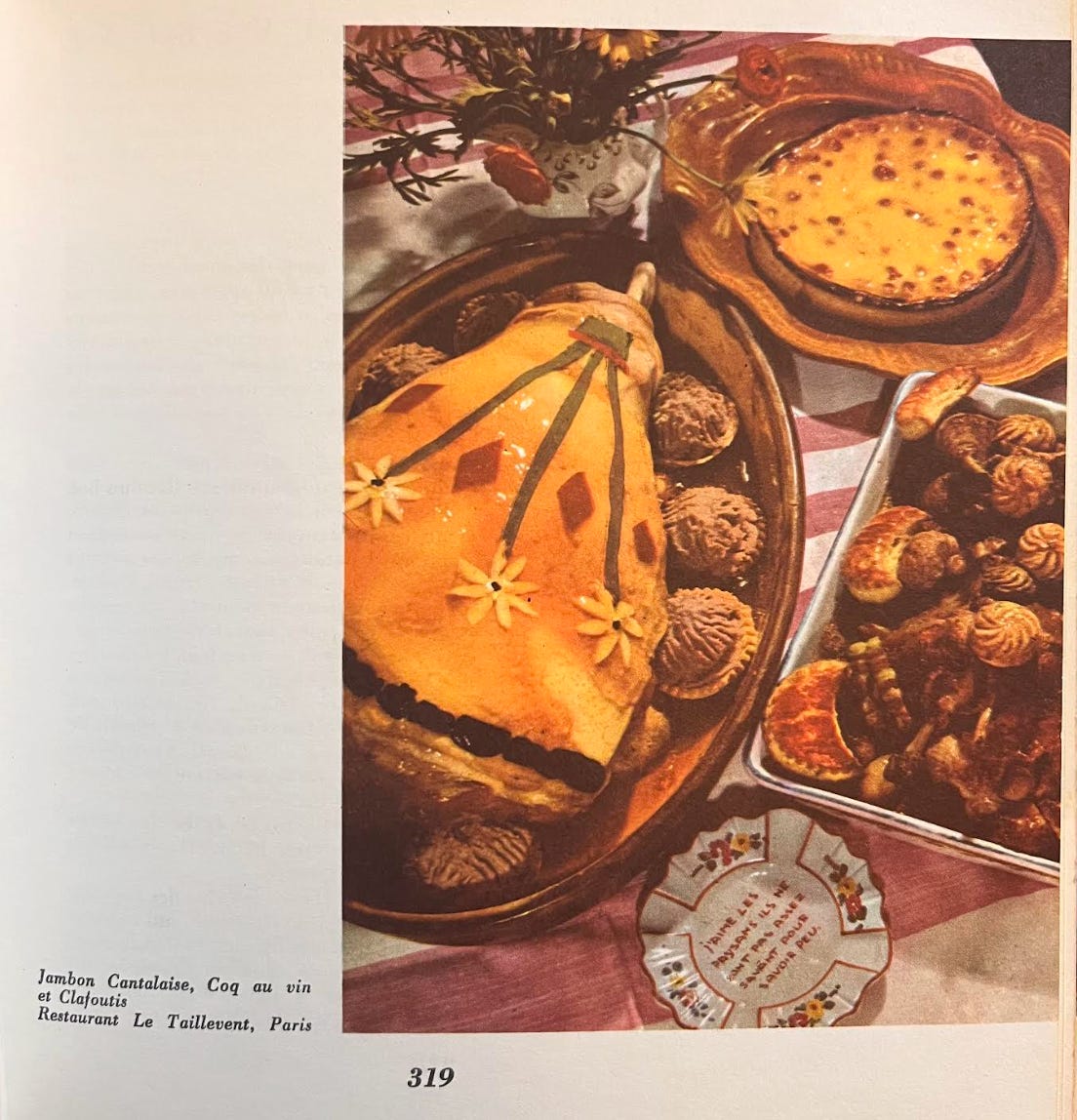
As I said above, I have been sorely disappointed in the past with the quality of each clafoutis I have made using recipes from various cookbooks. So I decided to figure it out myself and thought I would share my process.
I looked over recipes from several old French cookbooks and then several more recent cookbooks and websites (and blogs). I made a spreadsheet of about 10 of them from books or sites I trust. No two were alike - more or less eggs, more or less sugar, wildly different amounts of flour, even preparation techniques and oven temperatures varied… Using my own judgement and experience (or so I like to think), I took all of the historical and modern variations and consolidated (synthesized?) them, deciding the quantity of each ingredient I thought would work. I tested the recipe I had come up with. I found the cooked custard too dense and chewy, just too firm. The rest seemed to work, and the quantity of the sugar was perfect. So I cut back on the flour in the recipe, perfected the mixing method so I would be sure to have a perfectly smooth, lump-free batter, and baked the second one.
It was a revelation. Throughout my research, I had noticed that historic cookbook authors universally categorized the clafoutis as “un entremets chaud” — a hot dessert. They always insisted it be served warm from the oven, a traditional detail I’d neither noticed nor considered until that moment. Armed with this newfound wisdom, I pulled my second clafoutis from the oven and, unlike the first which I let cool completely, let it rest for only 5 or 10 minutes before slicing into it while it was still warm.
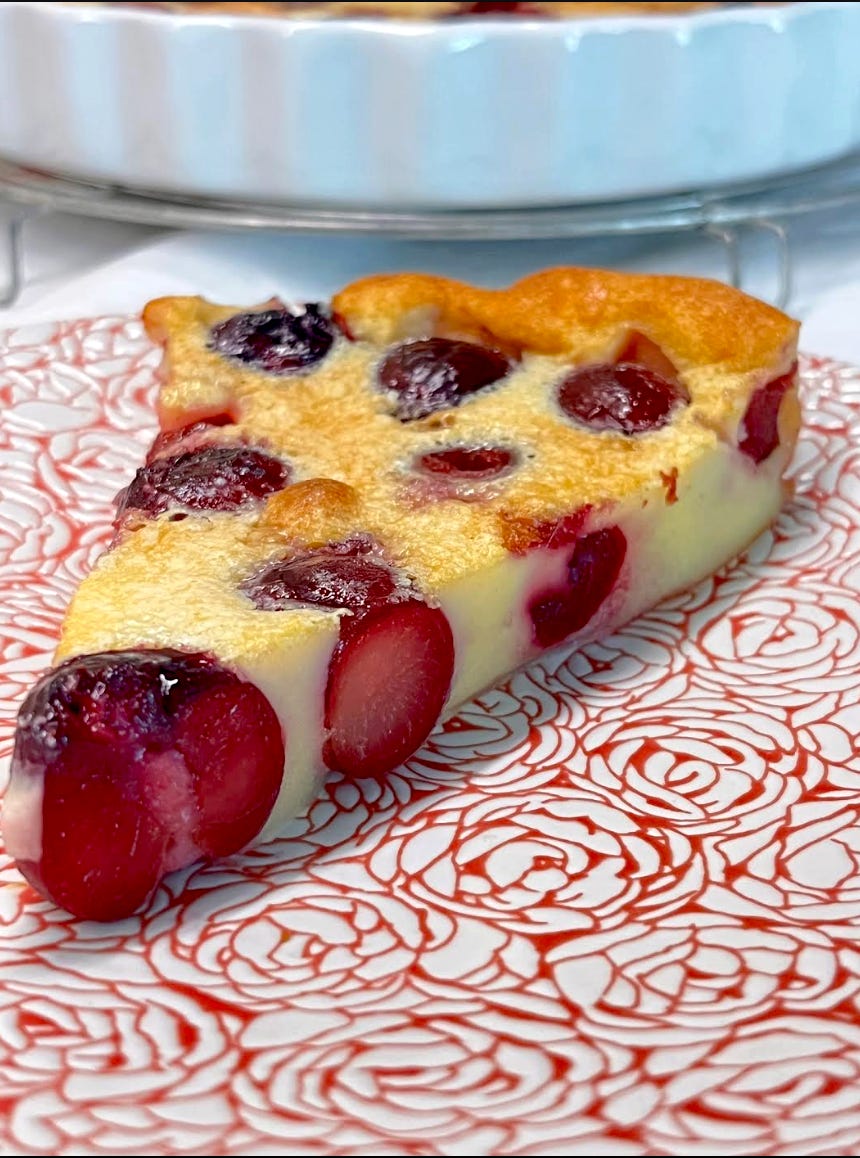
The result was absolute perfection. The quantity and set of the baked custard was just enough to hold the cherries in place, yet it remained incredibly velvety, creamy, and smooth. Very much like a thick, tender crêpe. Its gentle, milky sweetness was the perfect complement to the tart, flavorful cherries. Yet, even refrigerated overnight, the clafoutis remained creamy when eaten the following day. Although, if you like, don’t hesitate to warm the leftover tart slightly.
But, yes, I would heed Beaubrun and Leroy’s warnings and eat clafoutis in moderation…
“The children, eating clafoutis, smeared their faces with the cherries baked into the dense batter.” - Robert Burat, Jules Claretie, 1866
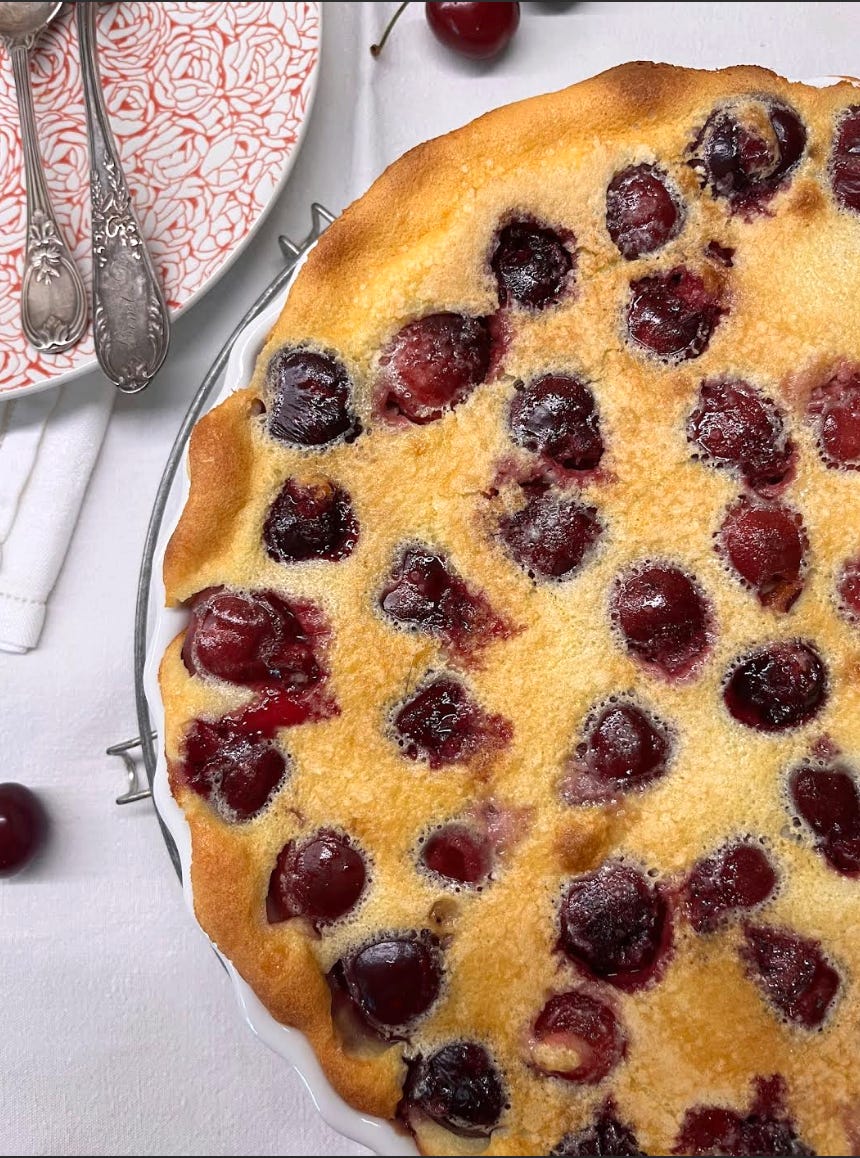
Clafoutis
1 pound (500 grams) dark, sweet/sour cherries
3 eggs, at room temperature if possible (each egg should weigh about 60-65 max grams)
1 teaspoon vanilla extract
½ cup (100 grams) sugar
½ cup (70 grams) flour * see note below
1 ⅓ cups (300 ml) whole milk or a blend of low-fat milk and heavy cream, at room temperature if possible
* note : to measure flour correctly, stir up the flour in the sack or container to lighten; lightly spoon the flour into the measuring cup until it’s above the rim. Using a flat blade, gently level the top. Weigh, if possible.
Preheat the oven to 350° F (180°C). Generously butter a 10-inch (25-cm) pie or quiche dish, making sure to butter well where the sides meet the bottom. Dust lightly with sugar.
Stem and pit the cherries and spread the pitted cherries in a single layer in the prepared pie/quiche dish.
In a large mixing bowl, whisk the 3 eggs until very well blended and just starting to thicken.
Whisk in the vanilla extract and the sugar until very well blended and the sugar is no longer grainy.
Whisk in the flour : to guarantee a completely smooth batter, sift ⅓ of the flour onto the egg/sugar mixture, whisk carefully until the flour is just incorporated (to avoid spatter), then vigorously until blended and smooth. Repeat with the second ⅓ of the flour, and then the last ⅓. This should give you a thick and perfectly smooth batter in which to add the milk.
Whisk in the milk or milk/cream until the batter is well blended.
Pour and scrape the batter onto the cherries in pie/quiche dish. Lightly dust the top with about a tablespoon of sugar.
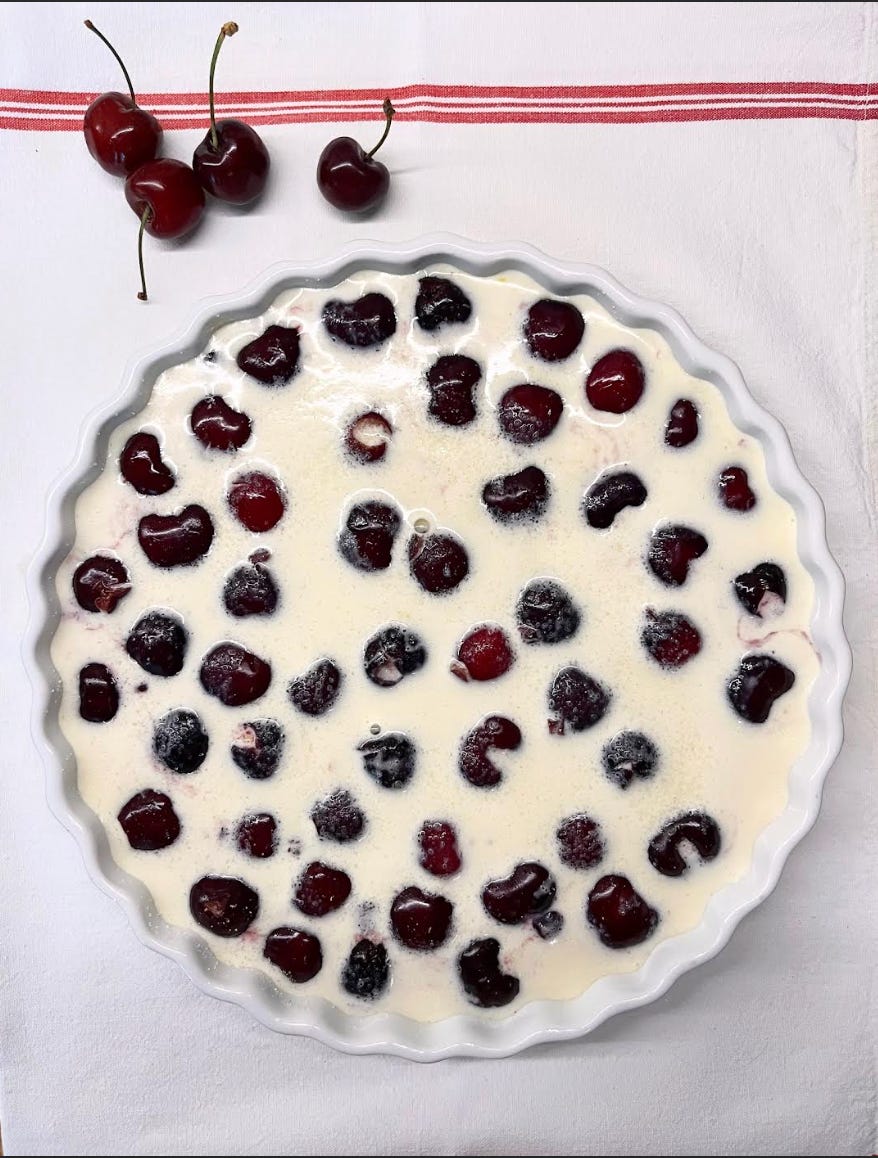
Carefully lift the dish and place in the preheated oven. Bake for about 45 minutes or until the clafoutis is puffed, just set, and a light golden brown.
Remove from the oven and serve hot — allow to cool briefly for 5 to 10 minutes only — or warm.
Store uneaten clafoutis in the refrigerator.
Thank you for reading and subscribing to my Substack Life’s a Feast. Please leave a comment, like and share the post…these are all simple ways you can support my writing and help build this very cool community. If you would like to further support my work and the creation and development of the recipes, please consider becoming a paid subscriber.
Oh you just made another perfect historic description and ended with a perfect recipe, thank you.
I have made a few clafoutis from the cherry trees in my son’s yard in the Cascade Mtns in Washington- Rainier cherries basically grow wild there! His 100-year-old trees are prodigious. My clafoutis, baked at 6000 feet, puffed up like soufflé, huge! Then settled down afterwards. Still delicious!