Flamusse aux Pommes
“An entremets that makes a pleasant dessert”

Desserts are loved by everyone. They play an important role in our diet, and our French concept of family meals gives them pride of place. - Jeanne Grillet, 1948
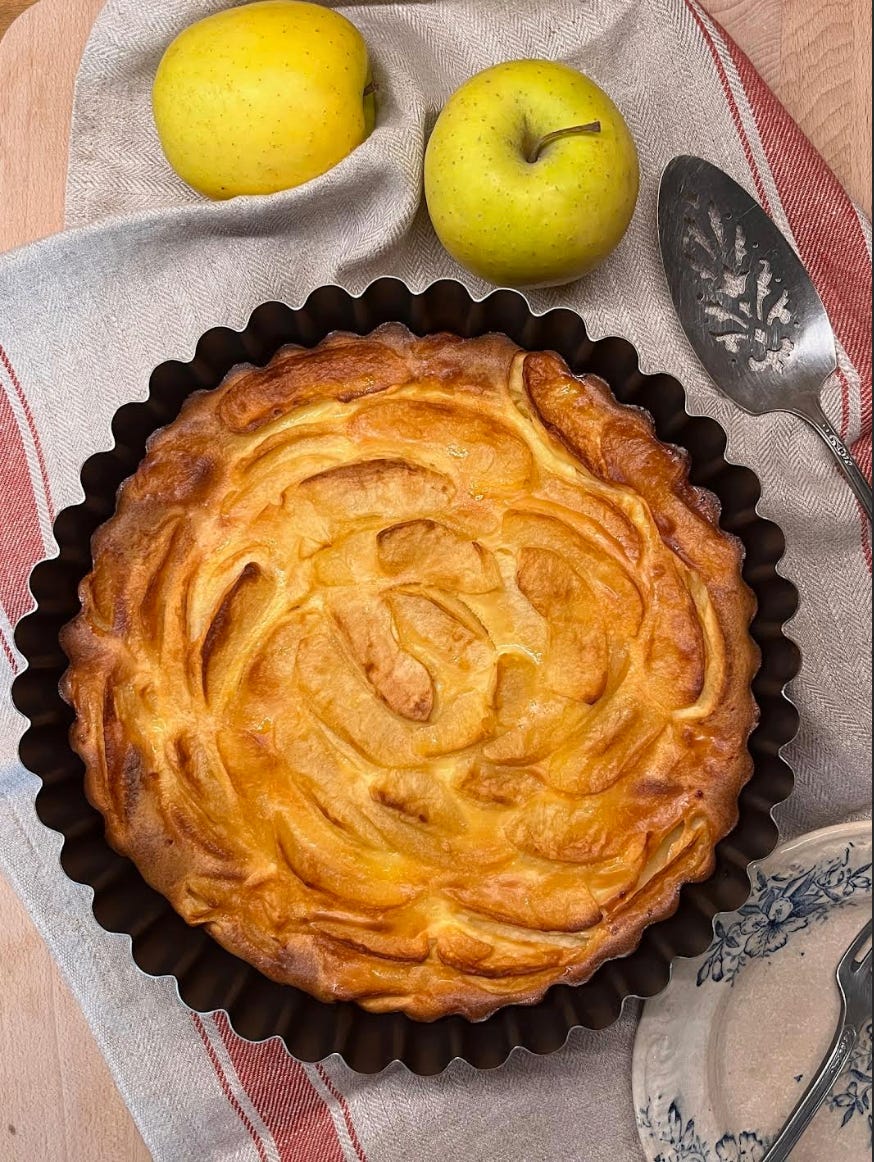
It’s worth making this just for the name.
Flamusse.
An unusual and enjoyable name. Flamusse.
Like the tôt-fait, the millas, crêpes, the clafoutis and the flognarde, the flamusse is a simple, homely treat made when time is short and fancier ingredients are wanting — or just not affordable. A dessert born of necessity and pantry staples. The flamusse is a rustic household preparation, a specialty of the region of Burgundy in France, made with basic ingredients found in every kitchen: eggs, milk, flour, and sugar. Sometimes savory and sometimes sweet, today it is most commonly found made with apples, when apples are grown locally and easy to come by in season, of course.
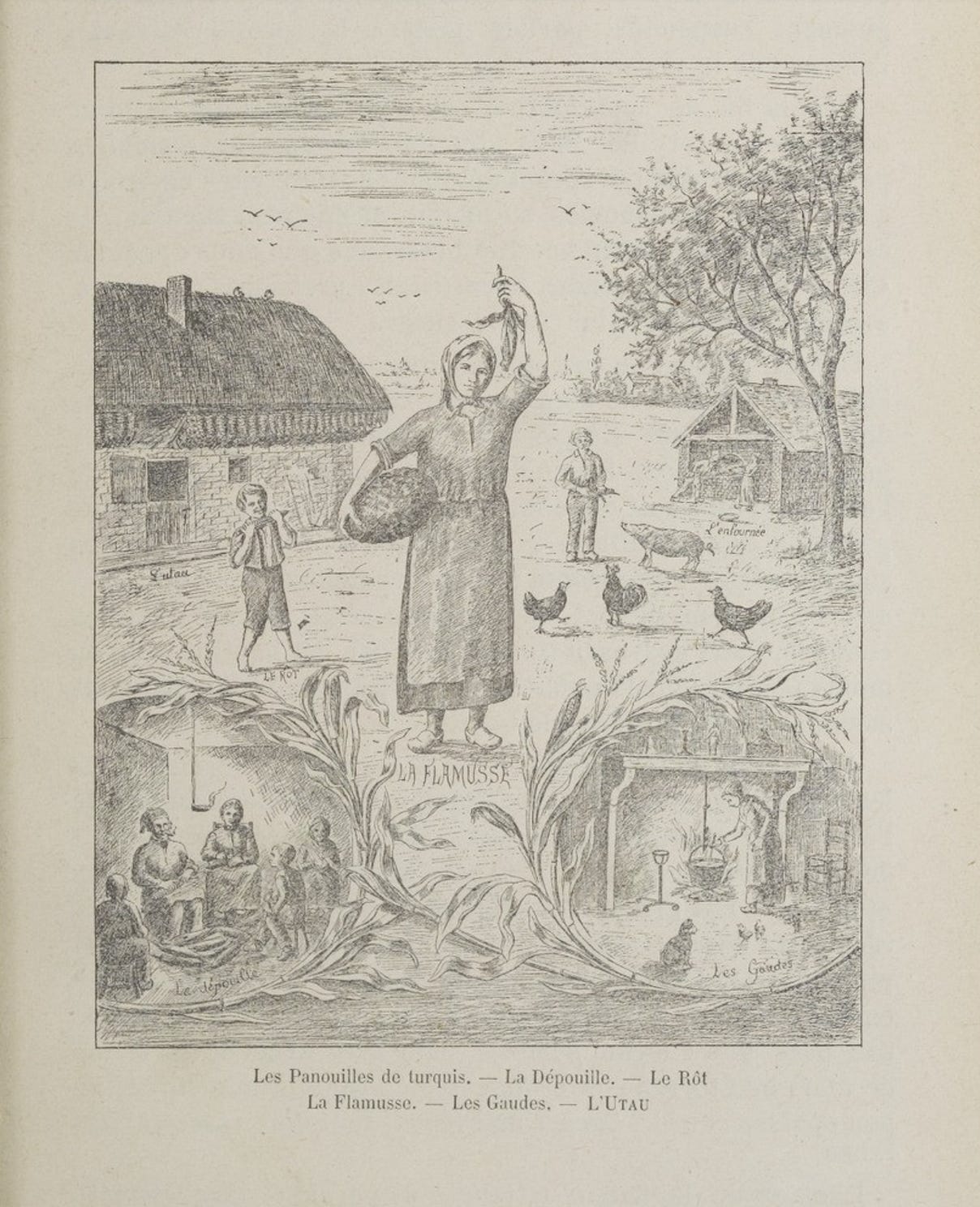
But the flamusse wasn’t always this delicious sweet egg-and-milk batter confection. In older Burgundian dialect glossaries, flamusse is described as a flat baked preparation made from maize — or corn — a galette or flatbread. In 1787 — the earliest written mention I could find of this curiously-named cake — Artus Bertrand grouped flamusse among enriched maize “cakes,” noting that in Burgundy such preparations were made by mixing toasted corn flour with milk or cream. This wasn’t a refined dessert, or even a dessert at all, but a rustic baked good, a compact, unleavened, unsweetened cross between a cake and a bread, a daily staple of the rural or peasant diet.
FLÀMUSSE, FLÉMUSSE, FLAMEÙSSE: small bread, country cake, kneaded with flour, corn or buckwheat, and seasoned with eggs, milk, and sometimes squash. All these local pastries have a most pleasant flavor. Housewives make them wonderfully well. - Dictionnaire du Langage Populaire Verduno-Chalonnais (Saône-et-Loire) by François Fertiault, 1896
Like those other baked goods, you won’t find the flamusse in many cookbooks, if at all, and certainly not in epicurean writings. To understand its origins and its place in French homes requires looking elsewhere — to studies of rural economy, agricultural reports, and sociological treatises that took an obviously intense interest in what ordinary people ate. Readers often ask how I can possibly trace the history of a home or peasant recipe when cookbooks — until the late nineteenth century — were written for noble or bourgeois kitchens. This is how.
In 1879, Dr. Lucien Guillemaut, describing daily life in the Bresse Louhannaise region of France, part of the historic region of Burgundy (today part of Bourgogne-Franche-Comté), notes that farmers ate flammusse alongside bread, milk, soup, cheese, and gaudes, another type of corn cake, daily — not as a dessert, but as part of their ordinary meals or refreshment — clearly everyday food, basic sustenance, rather than something special or celebratory. Corn first appeared in Franche-Comté during the 17th century. Its cultivation spread rapidly because this new cereal was exempt from tithes, was easy to grow, and kept well once the ears had been roasted in an oven. It was easily accessible and cheap, particularly a great source of flour before wheat became readily available in the mid-19th century, and thus a reliable source of nourishment.
Corn remained important in Bresse and parts of eastern France, but in Burgundy proper, wheat gained dominance in domestic baking in the latter half of the 19th century. Maize gradually became socially coded as “poor people’s food,” and yet the two variations of flamusse continued to coexist into the 20th century — by which time recipes began to appear in both cookbooks and newspapers. As late as 1909, the Journal d’agriculture pratique observed that corn was still eaten in the form of flammusse, “a thick pancake,” though its popularity was declining with the spread of white bread in rural areas — evidence of how gradually, yet slowly, culinary habits evolve.
Perhaps it was this shift from corn to wheat that subsequently transformed the flamusse from a sustaining flatbread into the sweet dessert we recognize today.
Or maybe it’s because — as was written in the 1928 Bulletin de la Société des Naturalistes et des Archéologues de l’Ain — “the fact is that this (corn) cake or flammusse is an unappetizing food and is difficult to digest. Sometimes, in modest households, a small cornbread is made on a whim when the oven is hot, declaring it to be pleasant to eat.”
Culinary traditions are tricky things.
In the 1929 quarterly historical journal Annales de Bourgogne, the flamusse was mentioned in an article on corn and millet, stating that a corn paste was used “to make a kind of flatbread, the tasty flamusse with a brown crust and golden crumb, which is still eaten today.” A few years earlier, the 1926 Larousse Ménagère (illustrated dictionary of domestic life) includes flamusse with 2 distinct definitions of this traditional baked good: a “Burgundy cake made with cheese, butter, eggs, and flour, similar to a gougère” and a “corn cake from Franche-Comté.” A mere ten years later, Prosper Montagné included flamusse in his newly written Larousse Gastronomique, describing this pâtisserie bourguignonne as “a kind of flan, made in a shortcrust pastry shell and filled with a cheese custard blended with eggs. Flamusse (a type of cornbread) is a specialty of Franche-Comté. Among the sweet treats of the Nivernais region, such as pâtis series and confections, we would mention: apple flamusse (a type of clafoutis).” Montagné applies the name flamusse to both versions.
The flamusse eventually took on the form of what was described as a “thick pancake,” made from the simplest of batters — the same foundation used for crêpes, tôt-fait, and clafoutis: milk, eggs, a little flour, and sugar to taste. When it finally began to appear in newspapers and the occasional cookbook in the early twentieth century, the recipe was strikingly consistent from one source to the next. And by then, apples had become an integral part of it.
I decided to make the recipe found in Austin de Croze’s 1928 Les Plats Régionaux de France, in the March 1950 issue of La France à Table, and in several other twentieth-century publications, reducing only the quantity of sugar. It was delicious, but thicker than I expected — closer to a lighter, creamier clafoutis or flognarde than to the “thick crêpe” a flamusse is traditionally said to be. So I made it a second time with less milk.
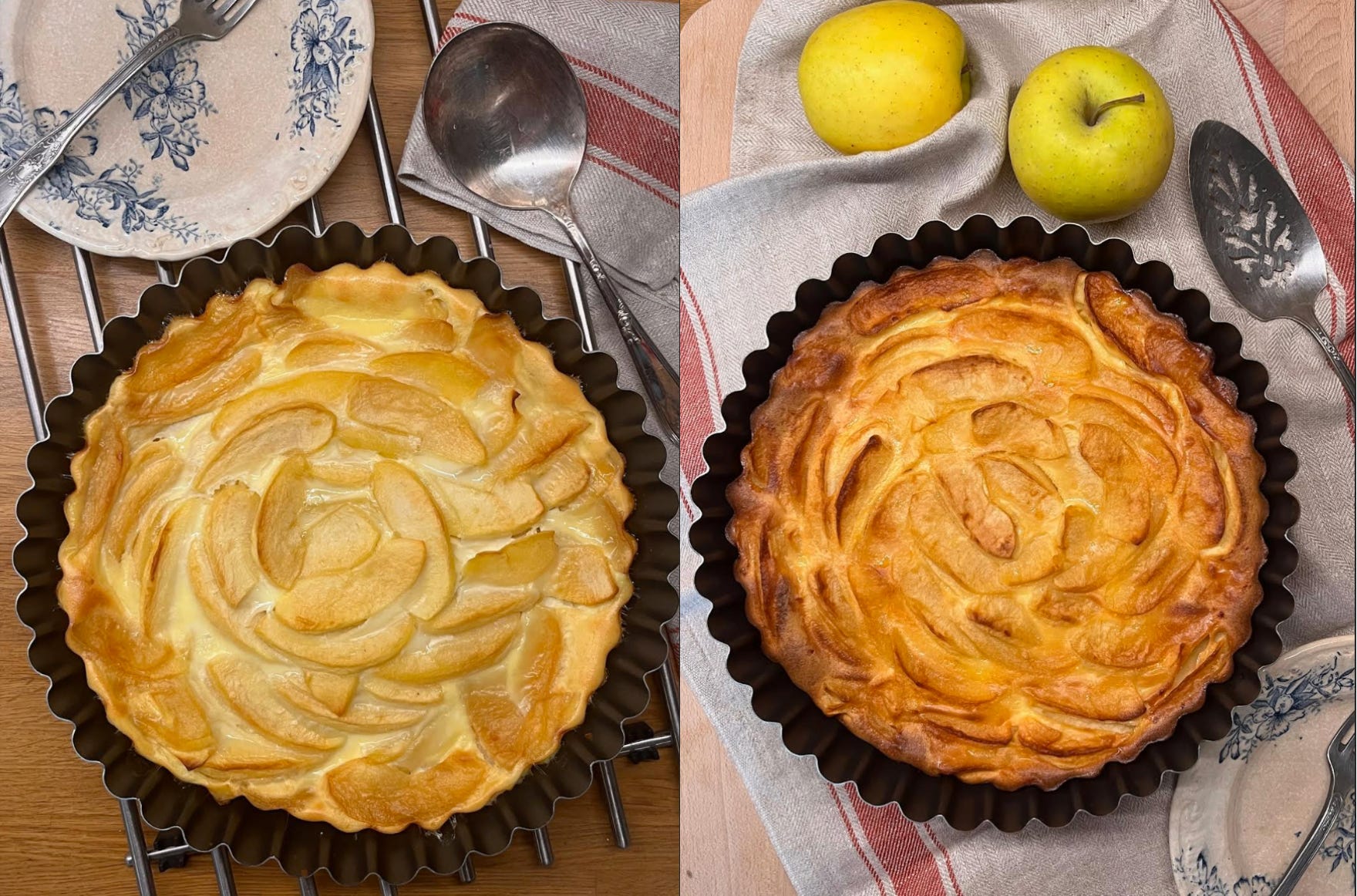
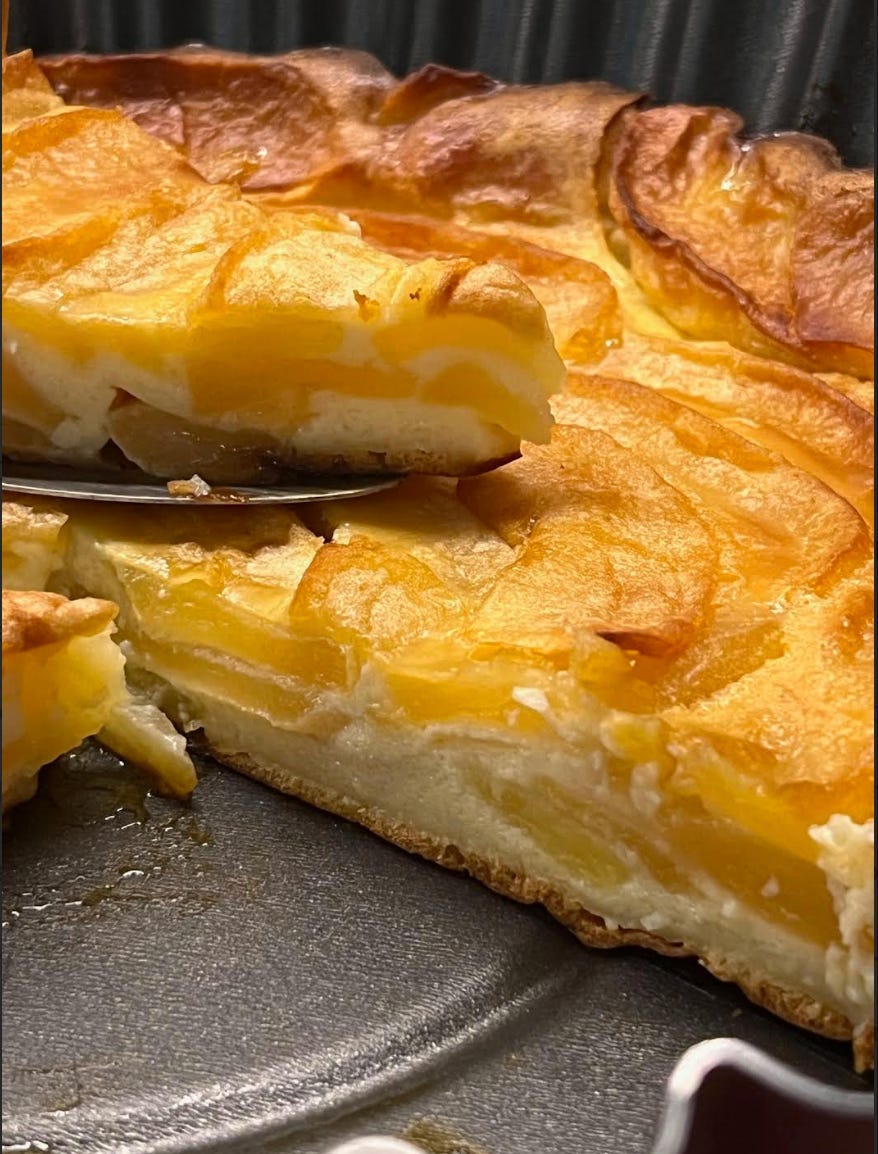
The second version, I believe, is closer to what I understand as authentic. Both are wonderful, absolutely delicious, so I’ll give you the two quantities of milk and let you decide. With more milk (2 cups / scant 500 ml), the flamusse custard bakes up thicker — thicker yet very light, very creamy, and delicately sweet. Using less milk (1 ½ cups / 300 ml), the custard bakes up thinner, like a thick, light and creamy crêpe, and, because there is less custard, the apples and the sweet, fruity apple flavor are more pronounced.
Perhaps the simplest description remains the best. In 1940, Le Républicain du Gard described the flamusse aux pommes as “an entremets from the Nivernais that makes a pleasant dessert. It is easy to prepare.” Nothing more elaborate was needed then — and none is needed now.
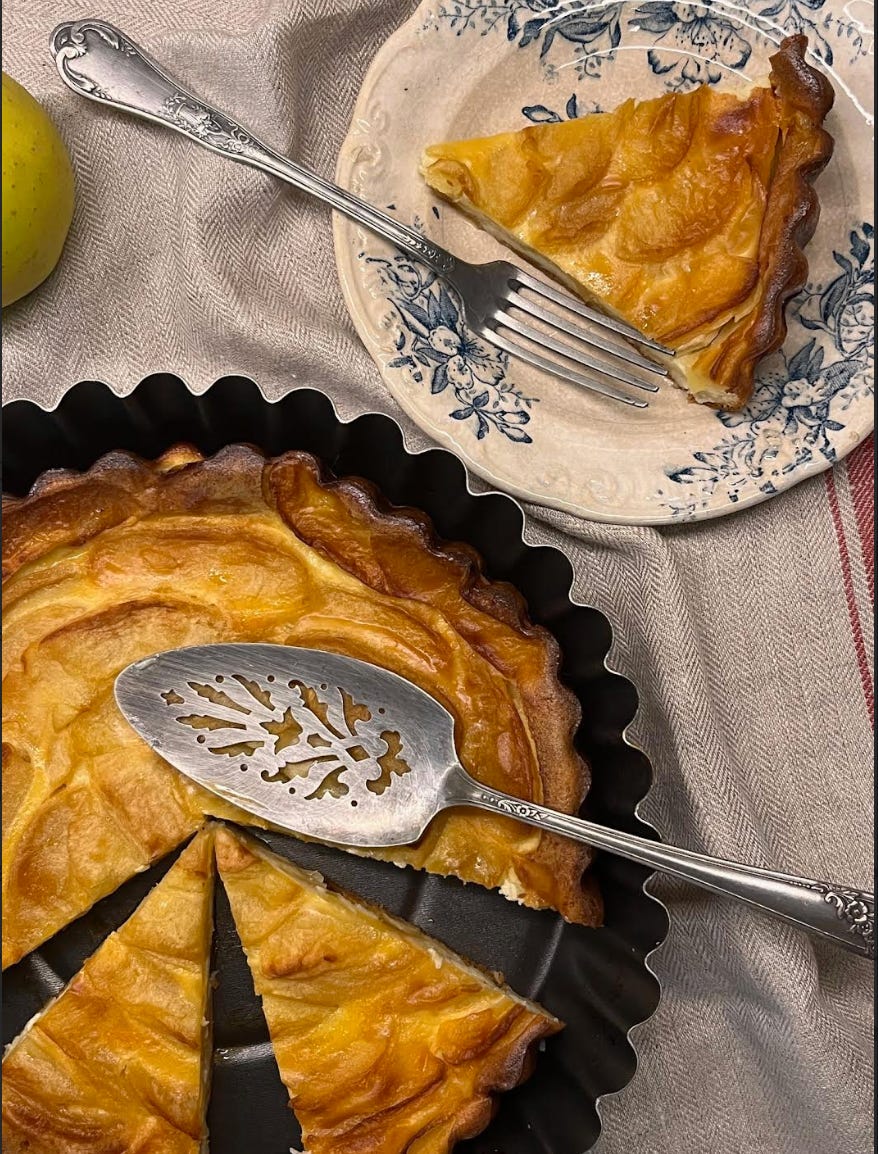
Flamusse aux Pommes
6 tablespoons (60 grams) flour
2 cups (scant 500 ml) milk OR 1 ½ cups (300 ml) milk
3 eggs
½ teaspoon pure vanilla extract
4 tablespoons + 1 teaspoon (60 grams) sugar
4 medium-sized apples — I love Golden apples for this
1 tablespoon butter
Place the flour into a large mixing bowl; whisk the flour with just enough of the milk to form a smooth, lump-free paste. Whisk in the eggs, vanilla, and sugar vigorously until well blended. Whisk in the rest of the milk. Set aside at room temperature while you preheat the oven and prepare the apples; whisk the batter occasionally.
Preheat the oven to 350°F (180°C°).
Generously butter the bottom and sides of a 9- or 10-inch (23- or 25-cm) pie plate or similar volume round can pan or baking dish.
Prepare the apples: peel and core 4 apples then slice thinly. Heat the tablespoon of butter in a large skillet, sauteuse, or frying pan and cook the apples over medium or medium-low heat, carefully stirring and turning often, for 10 minutes. The apple slices will be very tender yet retain their shape.
Whisk the batter to blend well and pour into the buttered cake pan, pie plate, or baking dish.
Arrange the apples in the batter, nudging them toward the center so that a ring of batter remains around the edge to bake into a rim.
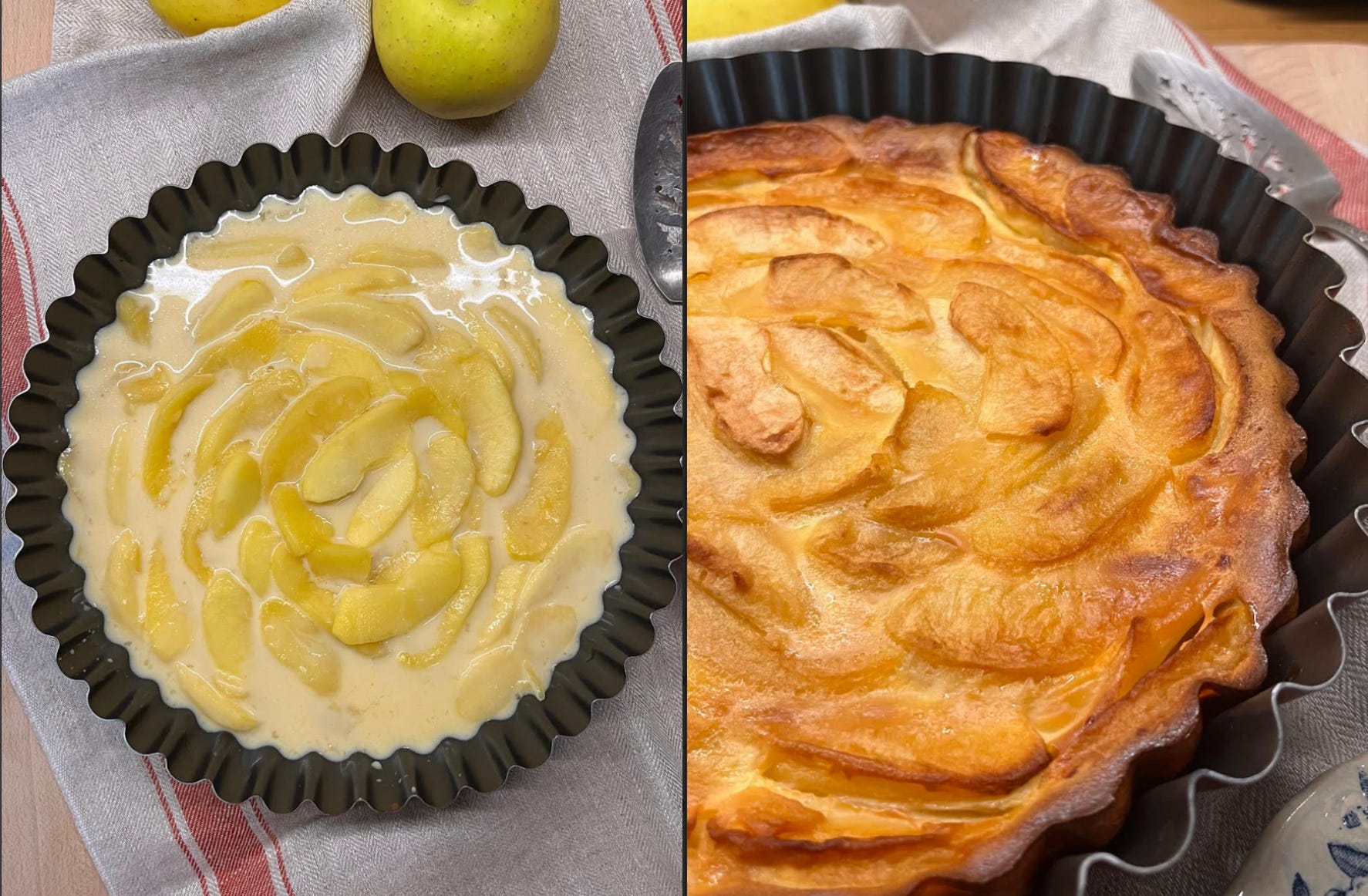
Carefully place in the oven to bake for about 1 hour 10 minutes or until set, puffed, and a deep golden brown.
Remove from the oven and allow to cool and settle for about 10 minutes before serving — and eating warm. Dust with powdered sugar or serve with ice cream, if you like, to turn a snack into a dessert.
Thank you for reading and subscribing to my Substack Life’s a Feast. Please leave a comment, like and share the post…these are all simple ways you can support my writing and help build this very cool community. If you would like to further support my work and recipes, please consider becoming a paid subscriber.
Made this last night and it was marvelous. So delicious I had to have a second helping, diet be damned.
What an interesting post Jamie. I’ll make this soon, I think I’ll try the lesser amount of milk to start with.