Rissoles
The little pastry that could.

I am fully satisfied with of all my labours, wishing that you and I may long enjoy the comfortable refreshments prescribed therein. - The French Cook (1653 English translation of Le Cuisinier François), François Pierre de La Varenne
Long, long ago, according to legend, the lands around the great medieval fortress of Coucy were terrorized by a ferocious lion “who had thick, long hair, a proud and hideous gaze, and bristling fur.”. The Lord of Coucy, Enguerrand II, slew the beast and freed the countryside. The victory was considered so momentous that a stone lion was carved and erected in the town square as a permanent memorial. A relief of the lion was also sculpted above the gate of the great tower of the castle.
This story of this glorious feat performed by the 12th-century Seigneur of Coucy, Count of Amiens is recounted, among other historians, by Maximilien Melleville in his 1848 history of Le Château de Coucy. From this victory, Melleville continues, annual festivities were instituted in Enguerrand’s honor. One extremely bizarre ceremony was performed by the Abbey of Nogent, which owed a feudal obligation to the Lords of Coucy. Three times a year, the abbot, or more commonly his tenant, had to present rissoles to the Lord of Coucy in the square where the stone lion stood. But, of course, this being the Middle Ages, a mere presentation wasn’t enough.
“The abbey’s tenant, entered Coucy on the mornings of Easter, Pentecost, and Christmas, dressed in a cloak of blue cloth to which rissoles were attached. He rode a light-colored horse whose ears and tail had been cut off and which was harnessed as if for ploughing. He was followed by a reddish dog, also without ears or tail, wearing a rissole around its neck. In this attire he awaited the officers of justice before the parish Mass. He then rode off among them, with a pack basket full of rissoles carried before him…”
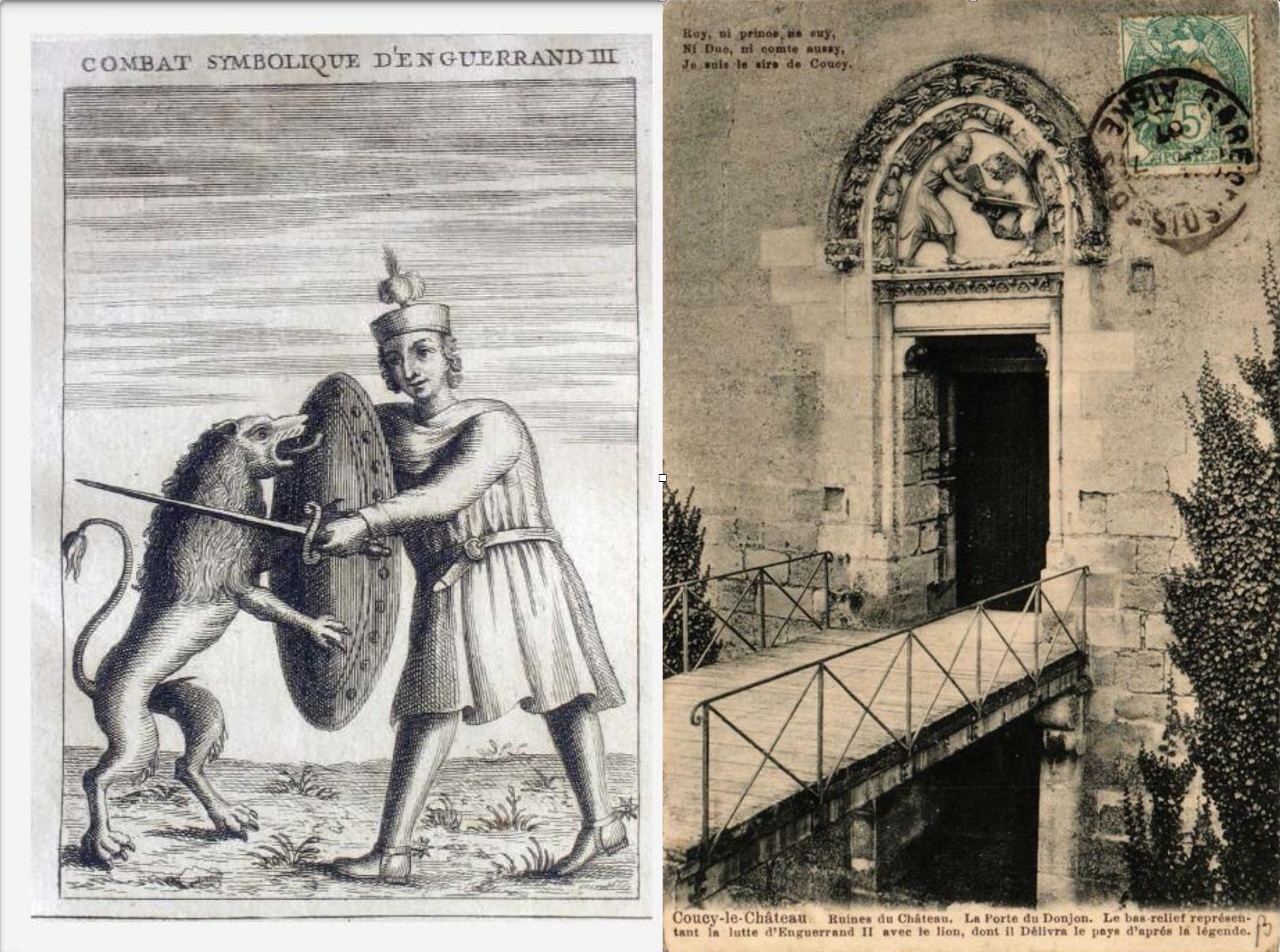
In 1728, Antoine de La Roque wrote of these festivities of rejoicing, still observed today “by the Abbot of Nogent - whose abbey was founded by the House of Coucy - [which] requires him to present, three times a year, rissoles (a kind of pastry) to the Lord of Coucy, or to his officers, at the place where the lion now stands. This is done in the presence of those same officers, who draw up an official record of the ceremony. This ceremony has continued uninterrupted to the present day, in memory of and in gratitude for the peace and security the inhabitants of the region enjoyed after the death of that cruel beast.”
Medieval France abounded in strange and wonderful customs. Just north of Paris and about sixty miles southwest of Coucy, the priory of the little village of Deuil was required to pay its taxes to the Lord of Montmorency in rissoles. “It owes,’ says an ancient manuscript, ‘at the four solemn feasts a certain due named roissoles (a type of pastry) with spice cakes ...; and in the event that there should be a failure of payment, as soon as the said Jehan (Jean de Montmorency) is served roast meat, the said prior is fined one muid [a large historical measure] of wheat for each omission.” - Paris et Ses Environs, Dictionnaire Historique, Anecdotique Partie 1 by Edme-Théodore Bourg, 1827
Neither Coucy nor Montmorency was unique in accepting food instead of money. Throughout medieval France, abbeys and tenants rendered dues in all kinds of goods, from bread, wine, and cheeses, to geese and fish, to cakes and pastries. It seems to have been more symbolic than economic - is it possible these foods found their way onto a nobleman’s table? - and I assume that the presentation was more important than what was being presented : in the Coucy ceremony, the Count’s officials were present and an official record (Acte & Registre) was made. This suggests the ceremony was about acknowledging the lord’s rights and reaffirming relationships rather than supplying his household with food.
But what are these rissoles (or roissoles) and what made them so special as to be accepted in lieu of money by one great lord, and offered to another as a ceremonial gift?
A Summary of the Comparison of the French and Latin Languages, Presented as Faithfully as Possible to Their Characteristics by Father Phillibert Monet, published in 1637, has an almost perfect definition for us :
Rissole: a small pastry made of ground tripe, covered with dough, in a half-moon shape, and fried in a pan. To “rissoler” means to fry something and form a crust of dough around it, in the style of a rissole.
Strangely, the very thing that distinguished the rissole - that beautiful golden crust - is what elevated it, at this time, to a high-status luxury food. Gervais du Bus composed the allegorical and deeply satirical poem Roman de Fauvel between 1310 and 1314, intensely critical of the corruption in the Church and the political system. His antihero, Fauvel, embodied the vices Flatterie (Flattery), Avarice (Greed), Uvrie (Arrogance/Pride), Variété (Inconstancy/Fickleness), Envie (Envy), and Lâcheté (Cowardice). Fauvel presided over a court obsessed with outward splendor and pageantry, both of which covered up the corruption, greed, and moral decay hidden beneath. The golden rissole was he perfect metaphor: crisp, golden, and enticing on the outside, all false gold, concealing whatever lay hidden (greasy indulgence?) within. When Fauvel marries Vaine Gloire (Vainglory), Fauvel and his companions dine on many of the popular and decadent foods of the time, among them “there were waffles and wafers, little goose pastries, tarts, and flans, spiced apples, darioles, crespines, beignets, and rissoles…”
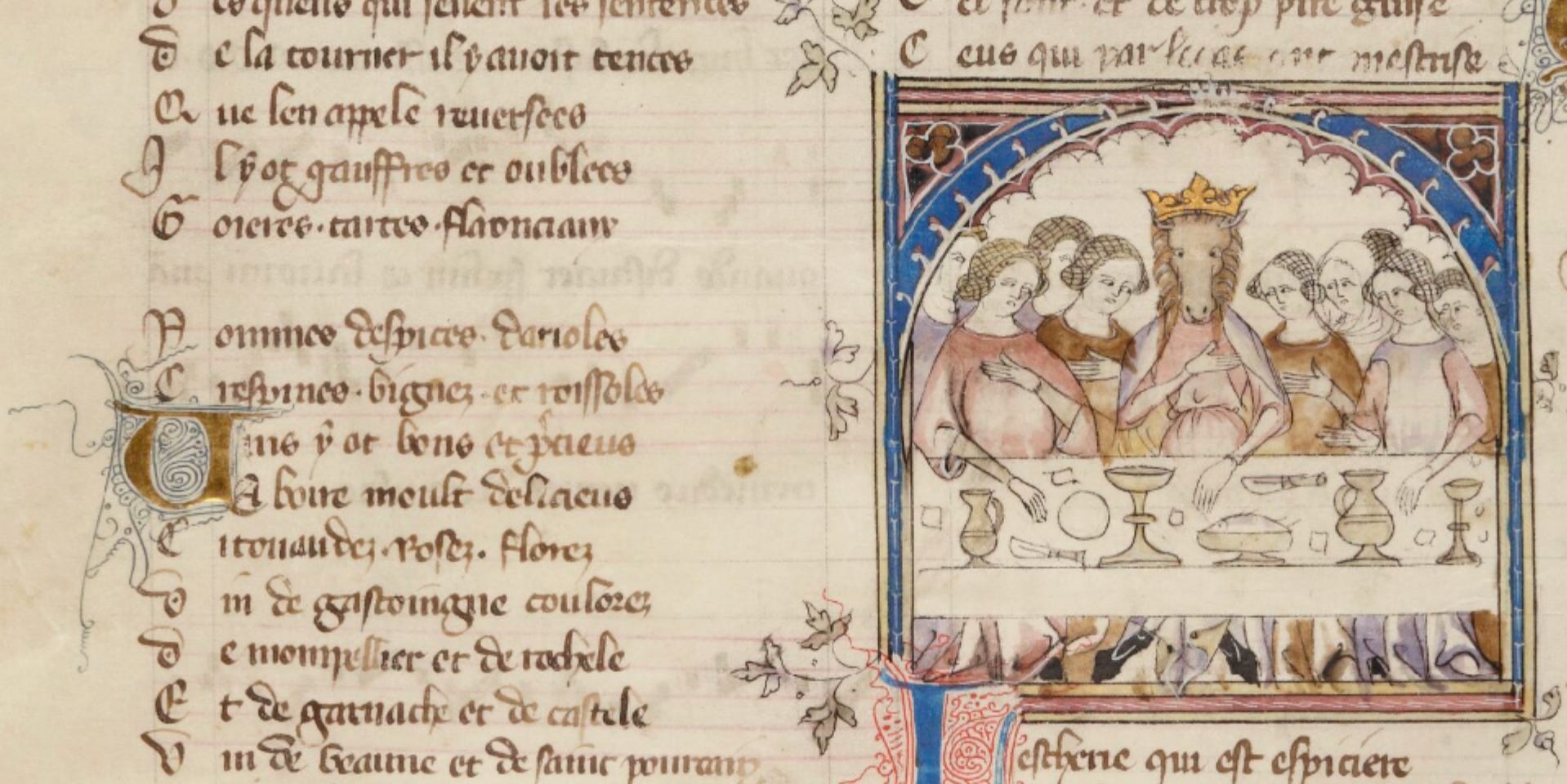
As we see, the rissole seemed to be an aristocratic indulgence, a high-end dish found in feudal ceremonies and courtly banquets. And yet, remarkably, and for all its prestige, these small savory fried pastries, hand pies if you will, were also popular street foods by the middle of the thirteenth century in France.
Ici il y a des oeufs, ici des poireaux.
Il y a des pâtés chauds, des gâteaux chauds.
Ici il y a du poisson de Bondies,
De chaudes oublies renforcées,
Des galettes chaudes, des échaudés,
Des rissoles ; par ici, des marchandises à jouer aux dés.
Here are eggs! Here are leeks!
Here are hot pies, hot cakes!
Here is Bondy fish!
Hot thick wafers!
Hot galettes! Échaudés!
Rissoles! And over here, pastries to be won at dice!
Guillaume de Villeneuve recorded and set down in print the popular cries of people selling fish, meat, fruit and vegetables, bread, cheese, butter, hot pâtés, cakes, milk, firewood, brooms, and dozens of other goods, including rissoles, on the streets of Paris - les Crieries de Paris - in 1265. De Villeneuve’s ancient poem of 194 lines is essentially a walking tour of medieval Paris through its sounds, specifically the cries of street vendors, and bears direct witness to the commonality and popularity of rissoles.
And yet, while Pierre Lacam claims that rissoles, among a slew of other pastries, were still being hawked on the streets of Paris in the 15th century, these little filled pies seem to have risen from humble peasant fare, if they truly ever were, to noble tables and religious feasts and were quite celebrated.
“The King was lunching,” wrote the Duchess of Montpellier in her Memoirs; “the Queen sent word asking for rissoles, and so did I. - Even the King lunched on rissoles. - L’Histoire de la Vie Privée des François, Pierre Jean-Baptiste Legrand d’Aussy, 1782
Although historian Legrand d’Aussy claims that 12th and 13th century rissoles were simply a kind of galette or pancake fried in oil or butter, we know that a century later they were definitely filled pastries.
The author of Le Ménagier de Paris in 1393, a prestigious nobleman, although exactly who is often debated, peppers his book with various recipes for rissoles. The filling for his rissoles for “les jours de poisson,” or lean days, is a lovely combination of chestnuts, hard cheese, hardboiled eggs, salt and seasoning (“pouldre”). One can, he suggests, replace the eggs and cheese with fish, specifically “cooked hake and crayfish, finely minced, or the flesh of pike or eel, together with chopped figs and dates.” His “rissoles en jour de char” - for days one is allowed to eat meat - are filled with finely chopped pork and hard-boiled eggs, then fried in pork fat. Although the author makes a point of adding “at the court of lords such as Monseigneur de Berry, when an ox is slaughtered there, the marrow is used to make rissoles.”
Of course, there is little chance that any worthy noble would have served something so bland at his table during a period when the most remarkable combinations of sweet and savory were de rigueur, and when spices were an integral part of every luxury medieval dish.
Ah, yes, the author continues : ““Likewise, they are commonly made with figs, raisins, cooked apples, and peeled walnuts to imitate pignolat, together with powdered spices. The pastry should be well colored with saffron, then fried in oil. If the filling needs a binder, use starch and rice as well. Likewise, the flesh of sea lobster may be used in place of meat.”
This book of domestic economy and instruction - which includes such topics as cooking, hunting, gardening, and even the social and sexual conduct of a young wife - also recommends serving rissoles with the dessert course alongside flans, and dried fruits and nuts, although he never revealed which ingredients transformed the recipe into sweet.
The rissole was definitely a filled pastry, and meat filling was an integral part of the recipe, when it wasn’t replaced with fish. “In the regulations issued to pastry chefs in 1440,” according to Legrand d’Aussy, “they were forbidden from using pork from diseased animals in rissoles. In the regulations of 1566, it was ordered that the meat they used be veal, mutton, or sliced beef. However, in addition to these rich rissoles, people continued to make lean ones that contained no fat at all.”
Maître Chiquart wrote down what would become, from the fifteenth century onward, the quintessential - the blueprint - rissole recipe, with only the filling ingredients varying here and there. And his sound excellent. Chiquart’s rosseolles, published in 1420, are much more luxurious and rich that that of Le Ménagier, the filling a blending of fresh pork, figs, prunes, dates, pine nuts, raisins, these dried fruits and pine nuts washed several times in good white wine, then drained before being chopped and mixed into the meat. He calls for the “best cheese available”, grated or finely chopped. He then stirs in a “large quantity of parsley, eggs, white ginger, grains of paradise, and saffron” and a generous quantity of sugar. The completed filling is then “delivered to your pastry cook”, who encloses it in pastry (”les dorures“), fries the rissoles in white pork fat (lard), decorates each with a small leaf of gold, arranges them on beautiful platters, and finishes them with a sprinkling of sugar.
Gold leaf, saffron, white wine washed dried fruits, no street food this! Chiquart’s extravagant and utterly delightful version of the rissole was prepared to be served on the table of his master, le comte et premier duc de Savoie, Amédée VIII.
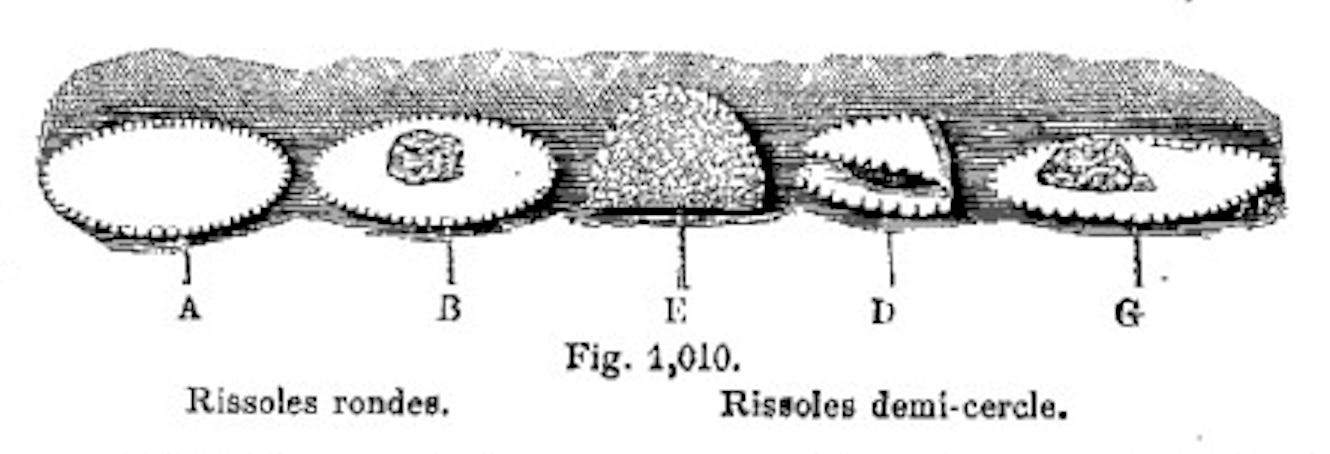
Pierre François de La Varenne - in his famous Le Pastissier François of 1653 - sets down once and for all the more everyday meaty recipe for this treat (albeit now a rather aristocratic treat), using “beef, mutton, pork, or veal, roasted or boiled then chopped quite finely, seasoned with a bit of “salty spices” which is then wrapped in pastry and fried on both sides in pork fat “until golden.” And he introduces us to rissoles feuilletées plus delicates, a fancier, more flavorful, savory-sweet, delicate rissole : “Boil or - better yet - roast meat until just underdone (as it will be better this way) - chopped with spices, raisins, pine nuts, a bit of sugar, and a little rose water. Wrap bits of this filling the size of an egg or a walnut, in puff pastry. Brushed for a glaze then bake in an oven. Once baked, remove them from the oven, dust with sugar, put back in the oven until glazed.”
2 years later, Nicolas de Bonnefons with his 1655 publication of Les Délices de la Campagne, also brings us a recipe for these elegant rissoles feuilletées, like La Varenne, making his with capon, a meat becoming more and more popular for this preparation, seasoning it with beef marrow, then also doing it up with raisins, pine nuts or pistachios, spices and sugar, wrapping the whole in puff pastry, glazing with sugar and egg white and baking.
While these new-styled rissoles are baked - obviously allowing the puff pastry to work its magic, and the glazing to bring that crispy, golden crust - the word rissole actually comes from the verb rissoler, to fry. So you will always find the traditional fried version in cookbooks alongside this baked version. In 1706, Pierre Richelet includes both versions of rissoles - “It’s a kind of small pastry; and there are several kinds.” - in the Dictionnaire François. He mentions both “the puff pastry pie filled with chopped capon, beef marrow, raisins, pine nuts or pistachios” and the “rissole commune” or common rissole - no puff pastry mentioned - filled with ground beef and beef marrow.
Antoine Furetière is much more straightforward in his own Dictionnaire Universel, 1690 edition, with a simple “type of pastry made with chopped meat and spiced, wrapped in a thin dough.” He seems to conclude that the word rissole comes, in fact, from the Italian fritelle - fritter - and claims that the French once called them frissoles.
As we move into and through the 18th century and then into the next, we find the now-standard rissole evolving in a different direction. The definition of the rissole and the method of preparing it had become firmly established, but the fillings grew ever more varied, allowing cooks to adapt the same pastry to every season, every table, and every taste. The rissole was never defined by what was inside, but by the pastry that enclosed it, its distinctive shape, and the final cooking method that endowed this delightful turnover with its crisp, golden exterior.
Louis Liger (1721) fills his with chicken or veal, spring or new onion, a little lard and chopped mushrooms. François Massialot (1722) brings into fashion the spinach rissole. André Viard (1822) adds both mushrooms and truffles and a reduced tomato sauce to his lamb filling. And by 1850, chefs are preparing the splendid, rather extravagant, and aptly-named rissoles à la Pompadour, a delicate fried pastry turnover filled with truffle purée, which is then dipped in beaten egg, coated in fine breadcrumbs, and served in a crown-shaped arrangement with a salpicon of finely diced vegetables, meat, truffles or mushrooms, sweetbreads or foie gras. This salpicon itself can replace the puréed truffle filling.
André Viard also delights his readers with rissoles aux confitures (jam-filled), à la frangipane (almond cream), and aux fruits nouveaux (with fresh fruit purée or compote) in his 1822 Le Cuisinier Royal.
Both M. Burnet (1836) and Alexandre Dumas (1873) offer an incredibly abundant choice of fillings for the savory rissole, but now offer a rather astonishing array of sweet rissoles, either building on Viard’s creations or as if just realizing that a sweet, fried pastry was an excellent idea. From rissoles à la moelle glacée, a rich combination of pastry cream, beef marrow, cream, and a few crushed bitter almond biscuits; rissoles filled with just pastry cream, either chocolate, coffee, saffron, almond or pistachio, and even “all sorts of fruits.” The dough for the apricot jam rissoles is made with cream and flavored with orange flower water and lemon zest and the spinach rissoles are sweet - like my own spinach frangipane tart - made with spinach, ground almond cookies, lime zest, butter, and orange flower water. Burnet offers rissoles à l’Itallienne made with a butter-and-egg-rich dough with a “filling” - no details - blended with both Neufchâtel and Parmesan cheeses, nutmeg and pepper, and egg yolks.
By the 1900s, we’re finding recipes for rissoles filled with all kinds of fruit and jams.
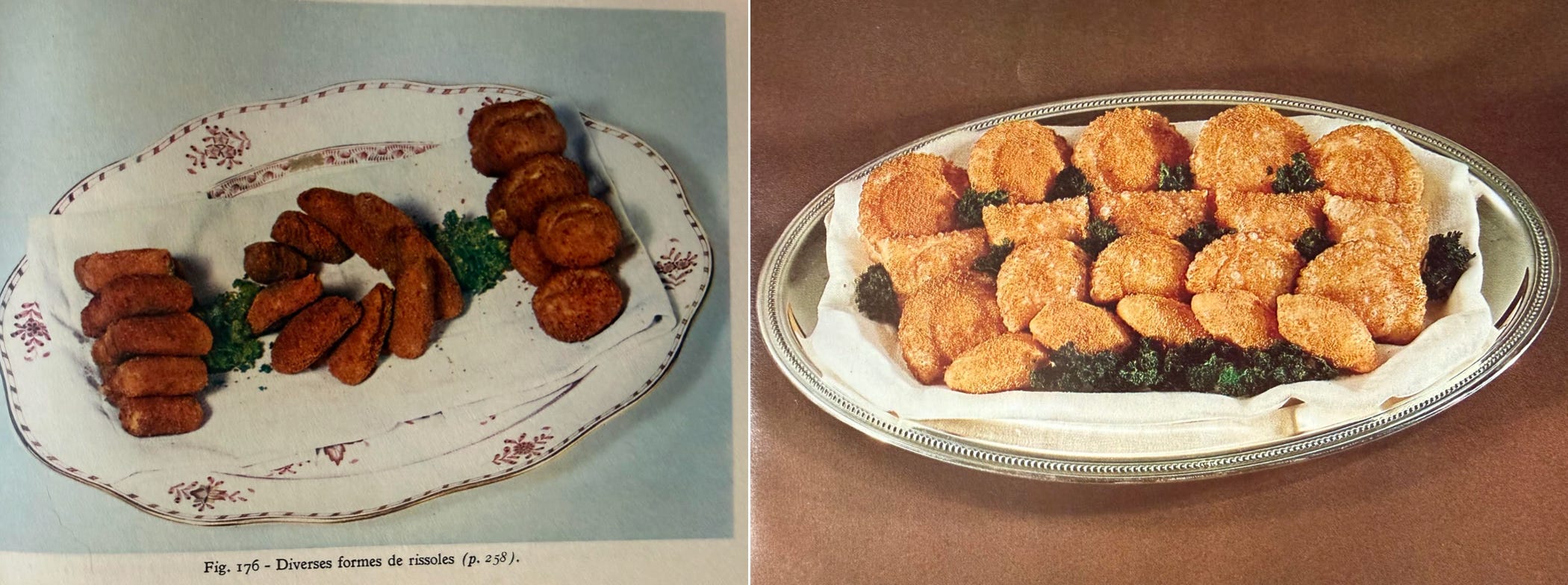
From Burnet (1836), to Urban Dubois (1889), to Henri-Paul Pellaprat (1950s), we know that these fried goodies are served as hors-d’oeuvres, entremets, or as garnish. According to an article in a 1939 issue of Marie-Claire magazine, rissoles are made to use up leftover veal roast, while a decade later, Henri-Paul Pellaprat considers the rissole “a very practical way to use up most any kind of leftovers - whether poultry, game, foie gras, fish, etc.- since these types of appetizers contain very little filling.”
Urban Dubois, just as practical as the others, wrote in 1888 that rissoles are prepared in order to use up puff pastry or shortcrust scraps as well as any excess chicken croquette preparation, which, I personally think, would make an excellent filling.
And yet, the more lavish, aristocratic rissole never went out of style, even as 19th- and early 20th-century chefs and culinary writers reintroduced the rissole back into economical kitchens and to more modest tables. Auguste Éscoffier proves that the humble rissole is in fact and always has been a gastronomic delight by using prized ingredients for the filling, like his rissoles à la Bohémienne filled with “two thirds foie gras” and “one third diced truffles,” the two made into a filling by stirring them together with a reduced demi-glace; his rissoles à la Bergère made with braised lamb sweetbreads, mousserons and morels, thickened with a thick Béchamel sauce; his rissoles Bouquetière with finely diced fresh spring vegetables, asparagus tips, Béchamel and cream. Rissoles à la Dauphine are enclosed in a brioche crust, the filling for his rissoles à l’Indienne are composed of lobster and a curried Béchamel… crayfish tails, pheasant and truffles, poached oysters, foie gras and tongue… noble, indeed.
But to be fair, M. Escoffier opens his list of fabulous recipes by describing rissoles as a “generic name for a hot appetizer consisting essentially of a salpicon, bound exactly like croquette batter and thoroughly chilled, whose main ingredient - such as poultry, game, foie gras, etc. - determines its name.” The important part, he concludes, is that the rissole is encased in “a pastry shell, made of either thin shortcrust pastry, semi-puff pastry, or pastry trimmings, or plain brioche dough without sugar.”
I guess it all depends on who is dining at your table.
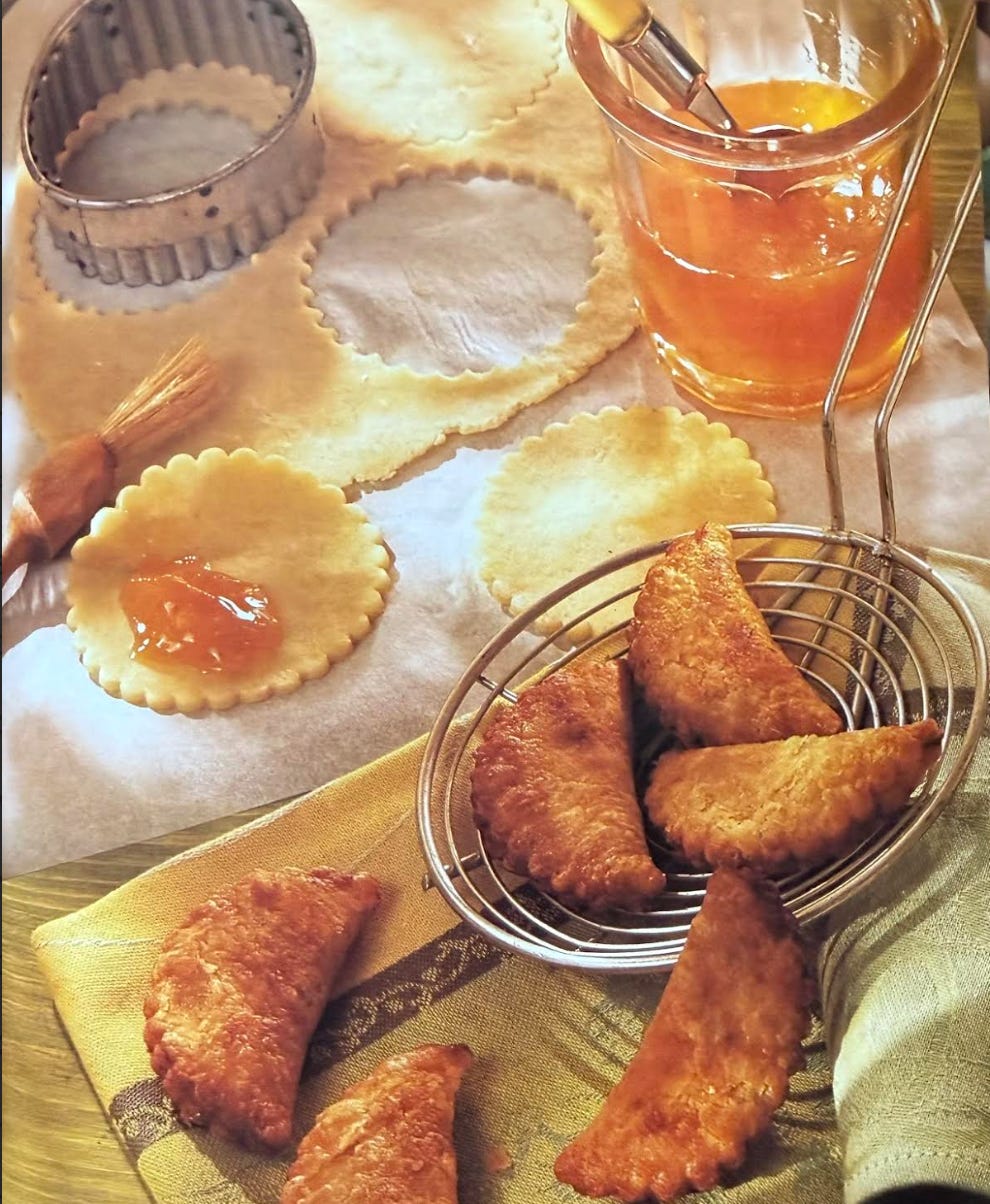
Having spent the past few weeks tracing the rissole through eight centuries of culinary history, I’m taking the liberty of going a little off-script with the recipe I’m sharing now. The heatwave has left me spent, and I’ve done little cooking these last few weeks other than making so many batches of jam for the hotel, something I do not have the luxury of skipping, not while summer fruits are in season.
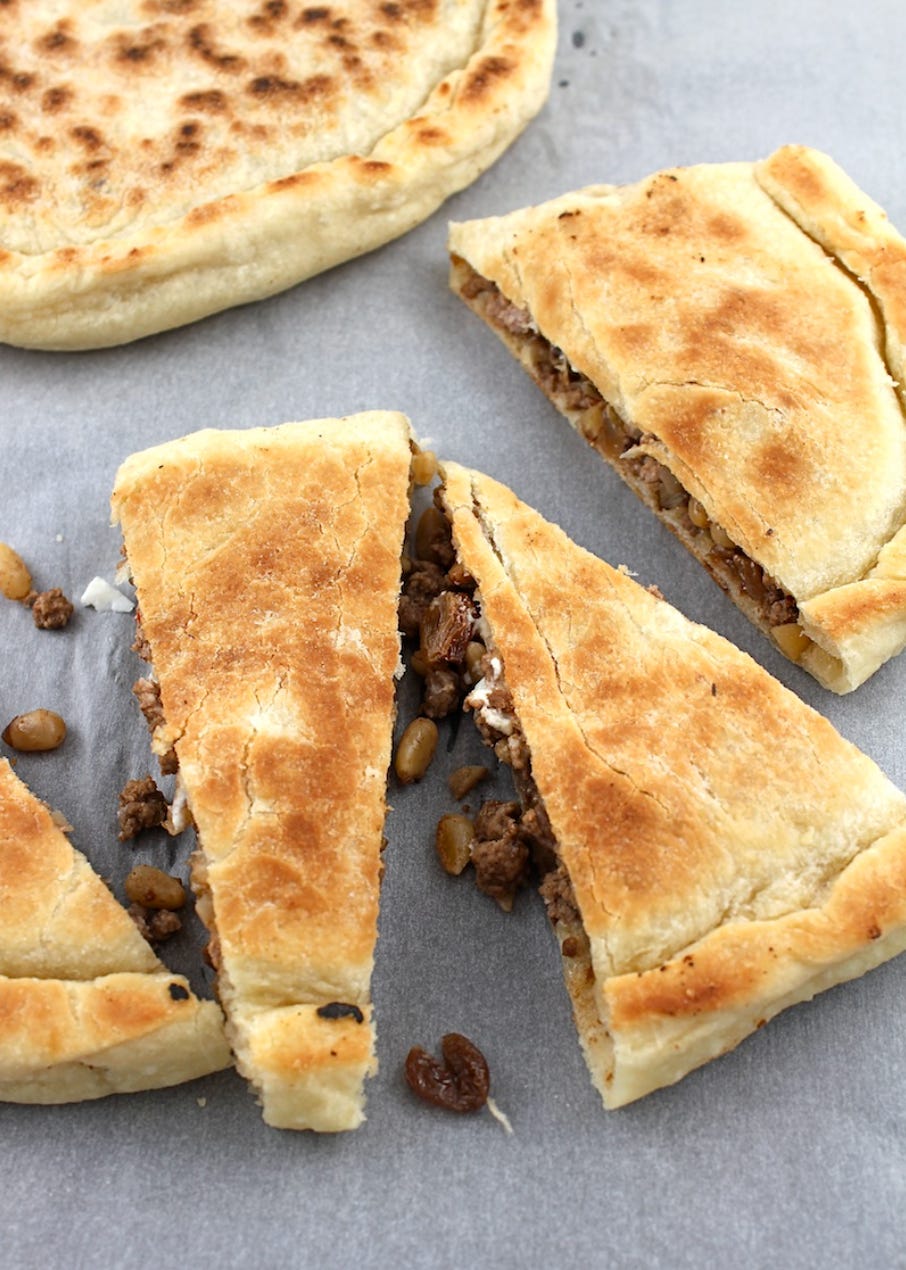
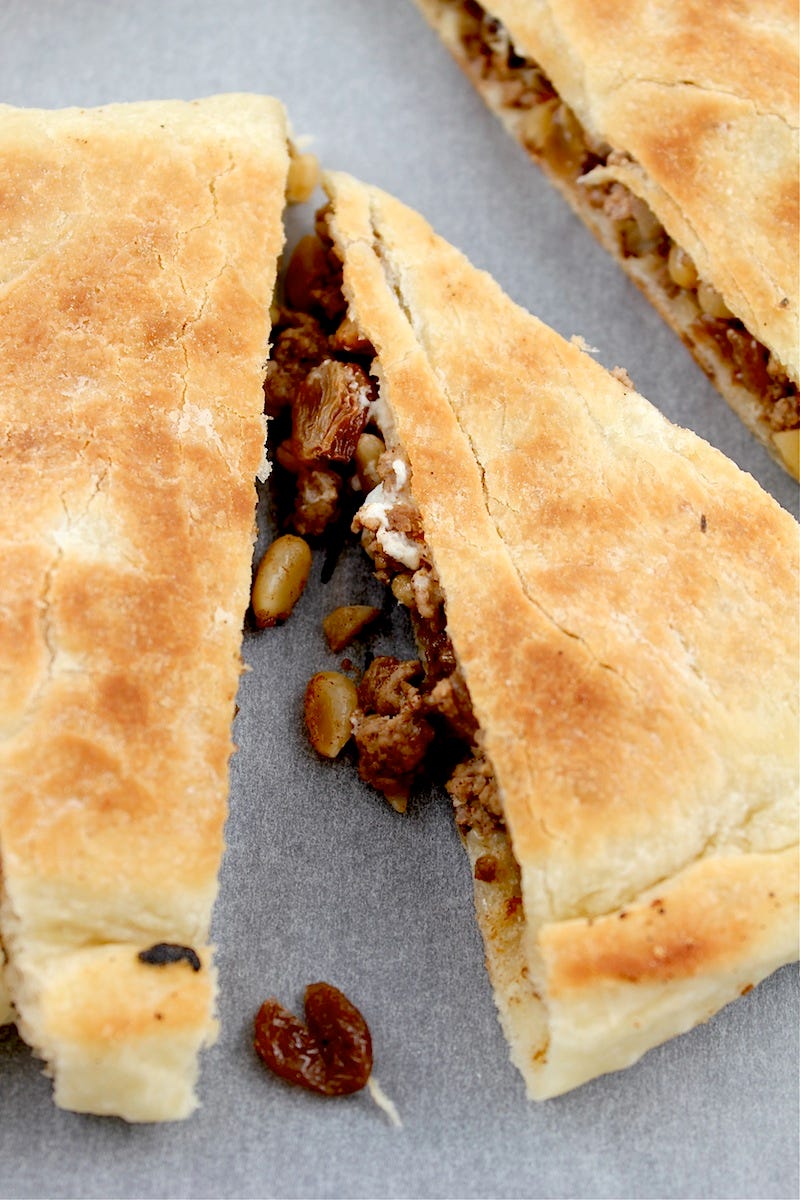
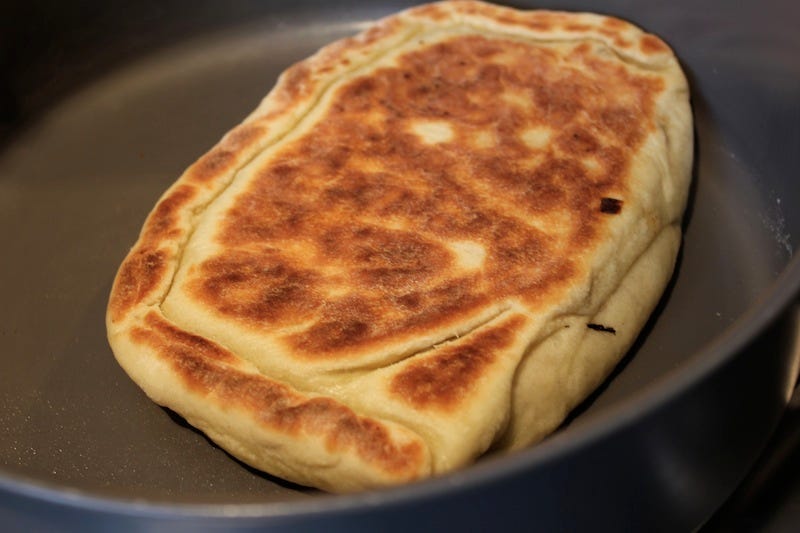
Today I’m sharing my recipe for Spiced Lamb and Feta Pastries. While the dough is a yeast bread-type dough (rolled out thin and delicate), the filling is reminiscent of those ancient recipes of minced meat seasoned with spices, the filling enhanced with raisins and pine nuts. I’ve started with lamb, although you can use beef or chicken. I added feta, which I love in this kind of preparation, a dash of pomegranate molasses for the tangy fruitiness reminiscent of medieval meat dishes, and a little tomato paste for the deep savory flavor. You can make changes to the filling as you like. These pastries are cooked in olive oil in a pan on the stove, giving the turnovers that beautiful golden crust.
You can prepare the filling ahead of time, just reheat gently where indicated in the recipe.
Spiced Lamb and Feta Pastries
I make 4 large pastries; you can make 4 or 6 smaller ones.
Dough
1 tablespoon golden or white granulated sugar
1 packet (about 2 ½ teaspoons or 7 grams) dry active yeast
⅔ cup (175 ml) warm water
1 ¾ cups (about 9 ounces / 250 grams) flour, plus more for kneading
½ teaspoon salt
2 tablespoons olive oil
Filling
2 ounces (50 grams) good-quality pine nuts
1–2 tablespoons olive oil
1 small to medium onion, chopped
2 cloves garlic, minced
1 pound (500 grams) ground (minced) lamb, or a combination of lamb and beef
1 slightly rounded teaspoon ground cumin
1 slightly rounded teaspoon ground coriander
¾ teaspoon ground cinnamon
¾ teaspoon ground chili or chipotle chili powder, or to taste
Salt and pepper
2 ounces (50 grams) raisins
2 tablespoons tomato purée, more to taste
2 tablespoons pomegranate molasses, more to taste, optional but good
4 ounces (100 grams) drained feta cheese, crumbled
Prepare the dough: Place the sugar and the dry yeast in a small mixing bowl. Add the warm/tepid (not boiling) water and allow to stand for about 15 minutes until the yeast is activated and the mixture foamy.
Put the flour in a mixing bowl and stir in the salt. Make a well in the center of the flour and add the yeast mixture and the olive oil. Using a wooden spoon, stir until blended and all of the dry ingredients have been moistened. Scrape the dough out onto a floured board or work surface and knead for 8 – 10 minutes, flouring the work surface and the dough only as needed. After 8 to 10 minutes, the kneaded dough should be smooth, soft and elastic, not dry but not sticky.
Lightly oil the inside of a medium to large bowl and place the round ball of dough into the bowl, turning the dough to oil evenly. Cover the bowl with plastic wrap and then a clean kitchen towel and set aside to rise, at least doubled in size, about an hour.
Prepare the lamb filling: Have everything prepared – the onion and garlic chopped, the spices, raisins and pine nuts measured out, etc.
Heat a skillet over medium heat. Add the pine nuts and cook very quickly, stirring constantly so they do not burn, just until toasted (they will begin to turn a golden brown). Remove quickly from the heat, scraping the pine nuts into a waiting bowl.
Return the skillet to the heat and add a tablespoon of olive oil. Add the chopped onion and cook over medium heat, stirring often, until the onion is tender and golden brown around the edges. Add the chopped or minced garlic and cook, stirring, for another minute until the garlic is tender but has colored. Add another tablespoon of olive oil and then the minced/ground meat and cook, stirring and chopping the meat to break up any lumps, until cooked through and browning, no longer pink.
Stir in the spices as well as salt and pepper until evenly coating the meat and cook, stirring, for a minute or two. Add the toasted pine nuts, the raisins, as well as 2 tablespoons each tomato purée and pomegranate molasses, stirring to blend. Cook, stirring, for a few minutes until the meat is done cooking and the ingredients are well blended. Remove from the heat and allow to cool just for a few minutes until just cool enough to handle. Taste and add more flavoring, salt, pepper, tomato paste or pomegranate molasses to taste.
If prepared ahead of time, gently heat the filling through until warm before preparing the pastries – adding just a bit of water while reheating will help to keep the mixture from burning as well as bring back moisture to the meat.
Make the pastries: Have both the warm (but not hot) filling and the crumbled feta ready. Also have ready a small bowl with several tablespoons of olive oil and a clean pastry brush as well as a good skillet or griddle.
Scrape the risen dough onto a floured work surface and divide into four even pieces. Working one piece of dough at a time, pat the dough into a rectangle and place on the board in front of you lengthwise perpendicular to your body. Gently roll the dough into a 8 x 10 inch (20 x 25 cm) rectangle, being very careful to keep the dough an even thickness and not to tear, split or weaken the dough.
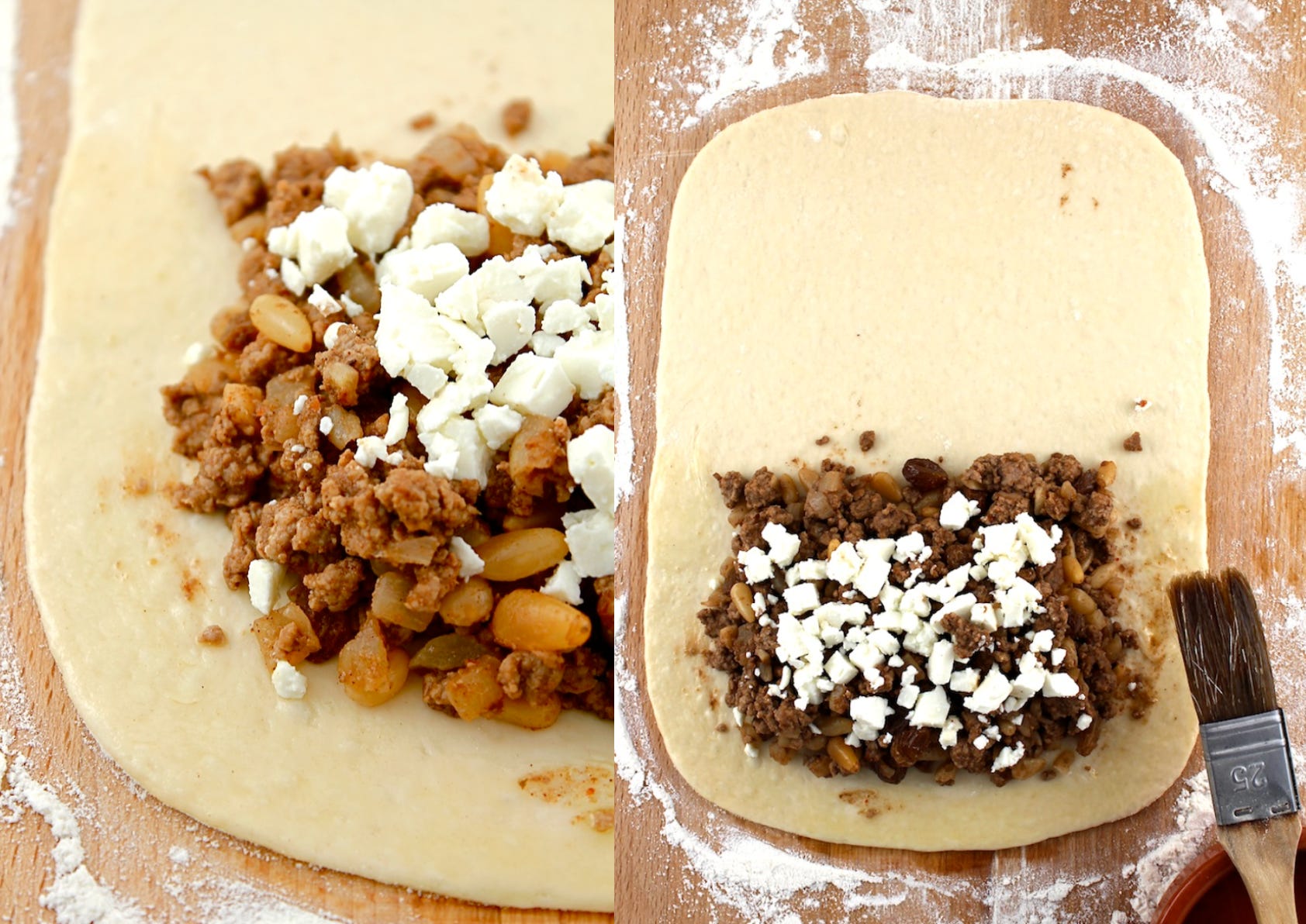
Place ¼ of the meat filling on the bottom half of the dough rectangle, leaving a ¾-inch (2-cm) edge on the 3 sides of the dough of the bottom half of the rectangle (the space covered by filling). Pat the filling until it evenly covers the space. (See photos)
Place ¼ of the crumbled feta cheese evenly on top of the meat filling.
Very gently and lightly brush a very small amount of olive oil on the edge of the dough - the 3 sides around the filling - and then bring the top half of the rectangle of dough down over the filling to create a pocket or turnover. Match the edges, pressing the top dough to the bottom and sealing.
Very gently brush the sealed edges with a bit more olive oil and gently roll the edge over onto itself to form a rim. Very gently brush/pat a bit of olive oil all over the top of the pastry, including the rim.
(I keep repeating very gently because the dough is incredibly light and fragile and it must not rip!)
Heat the skillet or griddle over medium heat. Very gently and carefully (the dough is soft and fragile and must not rip) lift the pastry off of the work surface (I use a pastry/cake lifter and my fingers) and, once the skillet is hot, flip the pastry into the pan olive oil side (the top) down and press all around with the back of a spatula for even cooking. As the pan-side of the pastry cooks, gently brush/dab the flip/bottom side (now facing up) with olive oil. Cook the pastry until the pan side of the dough is a deep golden brown – the dough will puff as it cooks – and then very carefully flip the pastry over to cook the other side until golden brown.
Serve hot!
Thank you for reading and subscribing to my Substack Life’s a Feast. Please leave a comment, like and share the post…these are all simple ways you can support my writing and help build this very cool community. If you would like to further support my work and the creation and development of the recipes, please consider becoming a paid subscriber.
I just love how you write. Such fascinating stuff.
You really deserve a television series. They are kinda like art history to me...food as art, and well, history. Thank you for sharing these informative and delicious writings which I love.